PART II / CHAPTER 5 / WHAT PEOPLE DON'T SAY
The fog found them again before noon.
By now, nobody was surprised.
The Navigator watched the clear water narrow ahead until the route disappeared into white.
The Captain raised the Spyglass.
Nothing.
The Scout pointed towards the nearest shore.
“There.”
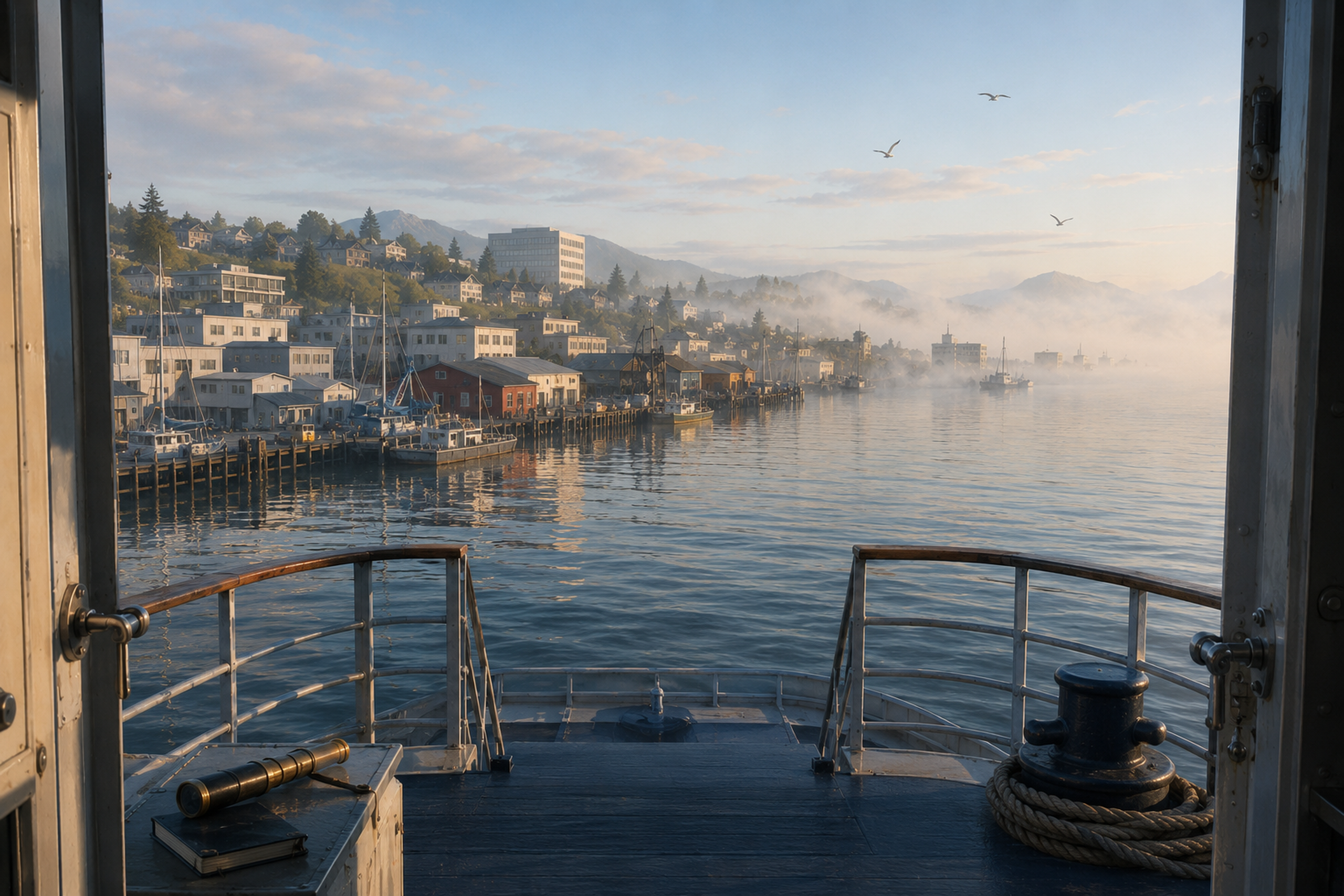
A working town surrounded a wide harbour.
Fishing boats.
Warehouses.
Shops.
Homes.
A ferry terminal.
Roads climbing away from the water.
Farther up the hill, a hospital.
The Navigator checked the chart.
“One harbour.”
The Captain lowered the Spyglass.
“Then that’s where we go.”
By the time they tied up, the harbour entrance behind them had almost disappeared.
DAY ONE
The fog showed no sign of moving.
They had the afternoon.
The Scout was first down the gangway.
Then his foot slipped on the wet stone.
He landed badly.
The Engineer reached him first.
“Don’t move.”
“I’m fine.”
His ankle was already swelling.
The harbourmaster disagreed.
“There’s a hospital twenty minutes inland.”
The Scout looked back towards the ship.
The fog had erased most of the harbour entrance.
“I suppose we’re not going anywhere.”
“Not on that ankle,” said the Captain.
The Scout complained for most of the journey.
The Observer ignored him.
At the hospital entrance, she noticed the first sign.
NO SMOKING.
Then another.
And another.
Smoking prohibited beside the entrance.
Smoking prohibited beneath the overhang.
Smoking prohibited along the walkway.
Then she saw a man smoking directly beneath one of them.
A few minutes later, a woman joined him.
The Observer looked at the sign.
Then at the smokers.
The Scout followed her eyes.
“They can read.”
“Probably.”
“So?”
The hospital doors opened.
The Scout was called inside.
The others followed.
The Observer stayed where she was.
Another smoker came out.
He looked left.
Then right.
Hesitated.
Walked a few metres.
Stopped beneath another No Smoking sign.
Lit a cigarette.
The Observer approached him.
“Can I ask you something?”
He looked at the cigarette.
“I know.”
“That wasn’t the question.”
He waited.
“Where are you allowed to smoke?”
The man looked around.
“Not here.”
“Where?”
He pointed vaguely beyond the hospital.
“Somewhere over there, I think.”
“Have you seen a sign?”
“No.”
“Do you know?”
“No.”
A nurse came outside.
The Observer asked her.
She knew where smoking was prohibited.
She was less certain where it was allowed.
A cleaner knew the same.
A visitor too.
More prohibition.
No obvious alternative.
By the time the Scout came back out, limping but otherwise fine, the Observer was still there.
The Engineer looked at the smokers.
“They can read.”
The Observer nodded.
“That’s still not the question.”
“What is?”
“Where should they go?”
Nobody answered.
The hospital had carefully designed the rule.
It had barely designed the choice.
The Navigator looked along the entrance.
“They know exactly what people must not do.”
The Observer nodded.
“But not what they should do instead.”
They started back towards the harbour.
The Observer looked over her shoulder.
Another person had appeared outside the hospital.
He read one of the signs.
Then stood almost directly beneath it.
The image stayed with her.
At supper, the fog still covered the harbour entrance.
The Scout had his ankle raised on a chair.
The Engineer had found ice.
The Observer was unusually quiet.
Eventually the Captain looked at her.
“What are you still thinking about?”
“The smokers.”
The Scout sighed.
“We know.”
The Observer ignored him.
“What did we believe when we first saw them?”
The Engineer answered immediately.
“They were ignoring the signs.”
The Navigator nodded.
“They didn’t care about the rule.”
“And now?”
The Captain thought about the people outside.
“Some were trying to work out where they were allowed to go.”
“Yes.”
“But they couldn’t.”
“No.”
The Observer pulled a page towards her.
At the top she wrote:
PEOPLE SMOKE UNDER THE NO SMOKING SIGNS.
The Scout read it.
“That’s what happened.”
“Yes.”
No interpretation.
No solution.
Just what they had seen.
The Observer wrote another line underneath.
BEFORE WE BELIEVED THAT PEOPLE SMOKING UNDER THE NO SMOKING SIGNS WERE SIMPLY IGNORING THE RULE.
Then:
NOW WE SEE THAT SOME PEOPLE TRYING TO COMPLY CANNOT FIND AN OBVIOUS ACCEPTABLE PLACE TO GO. THE RULE IS CLEARER THAN THE CHOICE.
The Captain looked at the two versions.
“The first is the observation.”
The Observer nodded.
“The second is the Discovery.”
The Engineer leaned back.
“So?”
The Captain looked towards the hospital lights on the hill.
“How often do we stop at the first explanation?”
Nobody answered.
The visible problem had seemed obvious.
People were smoking where they should not.
That could easily lead to an equally obvious response.
More signs.
Larger signs.
More enforcement.
But the first explanation had hidden something underneath it.
The people had a problem.
The hospital had a problem.
And they were not necessarily the same problem.
The Observer looked at the raw Discovery again.
“Maybe we spend too much time asking what is wrong.”
The Navigator looked at her.
“And not enough asking what people are actually living.”
The Captain nodded.
Some things hurt.
Consumed time.
Created frustration.
Added cost.
Forced workarounds.
Made ordinary life harder.
Pains.
But knowing what hurt was not enough.
People made choices around those pains.
They tolerated some things.
Spent money on others.
Waited.
Changed routines.
Accepted inconvenience.
Protected outcomes.
Something mattered enough to govern what they actually did.
The Captain looked at the page.
“Priorities.”
The Observer wrote the words together.
PAINS & PRIORITIES
One strange afternoon had not proven a method.
But it had given them a new lens.
The Scout looked at the fog outside.
“So tomorrow we go around asking everyone about their Pains?”
“No,” said the Observer.
“Good.”
“We need better ways of looking than that.”
The Observer pulled a clean sheet of paper towards the middle of the table.
They had done this before.
Once a lens became clear, they needed ways to search through it deliberately.
The Scout took the pen.
“What if we follow someone through an ordinary day?”
The Observer nodded.
He wrote:
DAY IN THE LIFE
The Navigator took the pen next.
“Some things only appear at certain times.”
“Such as?”
“Morning. Evening. Fridays. Month-end. Winter. School term.”
She wrote:
TIMELINE
The Captain took the pen after her.
“What happens before something? While it happens? What is left afterwards?”
The Captain wrote:
BEFORE, DURING AND AFTER
The Scout took the pen again.
“Go where people actually live with the problem.”
He wrote:
STREET SMART
The Navigator thought for a moment.
“What if we force the trade-off?”
“How?”
“If they could protect only one thing, what would it be?”
The Observer wrote:
THE ONLY THING I CARE ABOUT IS...
More Assignments followed.
BUSINESS AS USUAL
UNBELIEVABLE
THE NON-STAKEHOLDER
NO WAY, JOSÉ!
The Engineer looked at the list.
“We cannot do all of those tomorrow.”
“No,” said the Captain.
“That’s reassuring.”
“We don’t need to.”
She looked at the Assignments.
“We need different ways of looking so one kind of evidence doesn’t become the whole picture.”
The Observer found the small blank field cards they had used before.
They copied one Assignment onto each card.
A title.
A short prompt.
Portable enough to take ashore.
The full list stayed on the shared sheet.
The Navigator returned to the TIMELINE card.
“And some lives we can’t follow all day.”
The Observer nodded.
“Then let them record it.”
“Diaries?”
“Simple ones.”
Morning.
Midday.
Evening.
What they were trying to do.
What interrupted them.
What they waited for.
What they carried.
What they worked around.
What happened again.
And again.
And again.
Families.
Workers.
Shop owners.
People whose ordinary lives would continue after the crew returned to the ship.
The Scout looked at the row of field cards.
“So those are tomorrow’s Assignments.”
“Some of them,” said the Captain.
Outside, the fog pressed against the harbour entrance.
DAY TWO
They met on deck after breakfast.
The town was visible.
The sea beyond it was not.
The Captain looked towards the Flag.
Then the Spyglass.
Then the Assignment cards.
“Same Flag. Same line of sight. New Assignments.”
Nobody needed the rhythm explained.
A strange experience had given them a lens.
Now they needed to discover how much that lens could see.
They divided the cards.
The Observer and Scout took DAY IN THE LIFE and the simple diaries.
The Navigator took TIMELINE and BEFORE, DURING AND AFTER.
The Captain took THE ONLY THING I CARE ABOUT IS...
The Engineer pocketed BUSINESS AS USUAL and STREET SMART.
The others remained on the table.
They might need them.
They might not.
The purpose was not to complete a toolkit.
It was to search the lens.
They went ashore.
DAY IN THE LIFE
The Observer and Scout began with a family near the harbour.
Nothing about the morning looked remarkable.
That was the point.
Alarm.
Breakfast.
Children dressed.
Bags packed.
One missing glove.
Upstairs.
Down again.
Out the door.
The Scout noticed the same bag the father had carried the previous evening.
Laptop.
Charger.
Documents.
Lunch.
A pair of shoes.
Every morning, home to work.
Every evening, work to home.
Same route.
Same load.
Five days a week.
“Doesn’t that bother you?” the Scout asked.
The man looked at the bag.
“What?”
“Carrying it.”
He shrugged.
“It’s my work bag.”
That was all.
The Scout wrote it down.
Not because carrying a bag was automatically important.
Because some Pains survived by becoming too ordinary to mention.
The family had another routine.
They left early.
Very early.
The children waited at the connection.
Every morning.
The Observer watched the mother check the time.
Again.
Then again.
“What happens if you miss it?”
“We lose almost an hour.”
“Could you leave later?”
“Yes.”
“Why don’t you?”
The mother looked at her as if the answer were obvious.
“Because then we might miss it.”
The visible Pain was the early start.
But the family had already made the trade-off.
Sleep lost.
Certainty protected.
They left one of the diaries with the family.
Not an essay.
Just ordinary moments.
What happened.
What got in the way.
What they waited for.
What they carried.
What they worked around.
What happened so often that nobody thought to mention it anymore.
THE ONLY THING I CARE ABOUT IS...
The Captain spent part of the morning with a small manufacturer.
The owner complained almost immediately.
“Deliveries are too slow.”
The Captain listened.
Then showed him the Assignment card.
“If you could protect only one thing about deliveries, what would it be?”
“Speed.”
“Only one?”
He hesitated.
A delivery might arrive at ten.
Or three.
Or the next morning.
He kept two people available because he never knew when they would be needed.
The Captain tried again.
“What if it always arrived at three?”
“That would be fine.”
“Even if three is slower than ten?”
“Yes.”
She waited.
“So speed isn’t the one thing.”
The owner smiled reluctantly.
“No.”
“What is?”
“To know.”
The delay irritated him.
The uncertainty controlled his day.
That evening it became:
BEFORE WE BELIEVED THAT THE MANUFACTURER NEEDED FASTER DELIVERIES.
NOW WE SEE THAT HE WILL ACCEPT A SLOWER DELIVERY IF HE CAN RELY ON WHEN IT WILL ARRIVE. HE TRADES SPEED FOR CERTAINTY BECAUSE UNCERTAINTY CONTROLS HIS DAY.
TIMELINE
The Navigator followed a woman whose appointment lasted twelve minutes.
Her journey did not.
Bus.
Wait.
Connection.
Another wait.
Walk.
Reception.
Twelve minutes with the specialist.
Then the whole sequence reversed.
She mapped it.
Not only the appointment.
The preparation before leaving.
The journey.
The waiting.
The connections.
The time she kept clear in case something went wrong.
The return.
The rest of the day shaped around twelve minutes in one room.
A shorter journey would help.
A cheaper journey would help.
More frequent departures would help.
But none was why she made the journey.
She travelled because the expertise she needed existed in one place and she did not.
Back aboard, the crew recorded:
BEFORE WE BELIEVED THAT THE PAIN WAS SIMPLY THE LONG JOURNEY TO THE SERVICE.
NOW WE SEE THAT THE PERSON ACCEPTS HOURS OF TRAVEL BECAUSE ACCESS TO THE RIGHT EXPERTISE MATTERS MORE THAN CONVENIENCE. THE JOURNEY IS THE TRADE-OFF THEY ACCEPT TO PROTECT THE OUTCOME.
The Scout read it.
“No solution.”
“No,” said the Navigator.
“No moving the specialist.”
“No.”
“Good.”
They were getting better at that.
THE OTHER ASSIGNMENTS
The rest of the search produced more Discoveries than the few they would later remember best.
The Engineer used BUSINESS AS USUAL around the harbour.
Five businesses complained about deliveries.
Five businesses had vans.
Several crossed on the same ferry.
Half empty.
The complaint sounded like insufficient capacity.
The behaviour showed something else.
Each business tolerated wasted capacity because uncertainty felt worse.
The crew recorded:
BEFORE WE BELIEVED THAT THE HARBOUR BUSINESSES NEEDED MORE DELIVERY CAPACITY.
NOW WE SEE THAT THEY ALREADY HAVE SPARE CAPACITY. THEY TOLERATE HALF-EMPTY VANS TO PROTECT CERTAINTY THAT CAPACITY WILL BE THERE WHEN THEY NEED IT.
STREET SMART brought back exact words from shop owners, parents, harbour workers and patients.
BEFORE, DURING AND AFTER exposed Pains that began long before an event and continued long after it appeared to be finished.
UNBELIEVABLE found things people had stopped expecting anyone to fix.
Some Assignments produced strong material.
Some produced almost nothing.
That was fine.
The purpose was not to prove every Assignment useful.
The purpose was to turn enough stones.
By afternoon, the first diaries came back.
They were messy.
Which made them useful.
A parent wrote:
LEFT EARLY AGAIN. NOT RISKING IT.
A shop owner recorded three interruptions caused by a supplier whose arrival time kept changing.
A worker wrote nothing about his commute, but twice noted that he could not begin the next task because something had not arrived.
One diary contained a day built around a single connection.
Another contained the same bag.
Morning.
Evening.
Morning.
Evening.
Nobody wrote:
THIS IS MY PAIN.
They wrote:
Waited.
Called again.
Left early.
Paid extra.
Carried it home.
Took the longer route.
Moved the meeting.
Did it myself.
Maybe tomorrow.
Ordinary life did not label itself for them.
The crew had to notice.
Late that afternoon, the material began repeating.
Different person.
Same trade-off.
Different complaint.
Same Priority.
Different workaround.
Same underlying Pain.
The Engineer returned with another complaint about price.
The Scout looked at the behaviour.
“Reliability again.”
The Navigator brought another story about waiting.
The Captain read the Timeline.
“Outcome over convenience.”
The Observer opened another diary.
Different handwriting.
Familiar trade-off.
She closed it.
“We’re hearing ourselves coming back.”
Nobody needed the phrase explained anymore.
They had not found every Pain.
They had not mapped every Priority.
They had not run every Assignment.
They had searched until another round was increasingly likely to produce another example of something already on the table rather than materially change what they could see.
The Captain looked at the Assignment cards.
Some covered in notes.
Some barely used.
Some not used at all.
The purpose had never been to complete the cards.
It had been to search the lens as far as the time allowed.
She looked at the first observation from the hospital.
PEOPLE SMOKE UNDER THE NO SMOKING SIGNS.
One accident had taught them where to look.
The Assignments had taught them how to look deliberately.
And the search had taught them something the hospital alone could not.
A Pain showed where life hurt.
A Priority showed what mattered enough to govern the choice.
The Captain looked around the table.
“And the first explanation?”
The Navigator answered.
“Where we start.”
The Observer finished it.
“Not where we stop.”
The Captain drew a line beneath the final Discovery.
“Freeze it.”
The Engineer looked at the collection.
“All of it?”
“All of it.”
“No ranking.”
“No.”
“No polishing.”
“No.”
“No deciding which one fits something we already know how to do.”
The Captain looked directly at him.
“Especially that.”
The warning mattered.
A capability looking for a problem could make every life resemble an excuse to use the Railway.
That was not why they had gone ashore.
They had gone to understand first.
The Observer placed the frozen collection beside the previous ones.
UNFAIR ADVANTAGES.
DOMAIN ORTHODOXIES.
PAINS & PRIORITIES.
Three bodies of Discovery.
The Engineer looked between the first and the third.
Some combinations were already tempting.
The Captain noticed.
“Don’t.”
“I didn’t say anything.”
“You were about to.”
He smiled.
She was right.
They were not making futures yet.
Outside, the fog still covered the harbour entrance.
The Scout looked through the window.
“Tomorrow morning?”
The Engineer did not look up.
“I am refusing to participate in this superstition.”
DAY THREE
The Observer woke before sunrise.
She knew before she reached the deck.
The light was different.
The harbour entrance had appeared again.
The fog had not gone.
It had pulled far enough away to leave a navigable strip beyond the breakwater.
Farther out, another pale bank waited.
The Captain came up behind her.
“Three.”
The Engineer emerged from below deck.
“No.”
The Scout followed.
“You haven’t even heard what she said.”
“I know what she said.”
The Navigator brought the chart.
The Captain raised the Spyglass.
Clear water.
Enough to move.
Still no destination.
The Navigator studied the route.
“There’s another harbour before the visibility closes again.”
The Captain kept looking.
“How much margin?”
“Enough.”
She lowered the Spyglass.
“Then we use the opening.”
The Navigator marked the port.
Beside it she wrote:
PAINS & PRIORITIES
The Observer looked back towards the town.
The hospital doors were already open.
People would walk beneath the same signs.
The harbour businesses would begin another day.
The manufacturer would plan around an arrival time he could not control.
The family would leave home early.
The woman with the specialist appointment would spend hours reaching minutes of expertise.
People would carry the same bags.
Wait at the same places.
Take the same detours.
Protect the same things.
Most would not think of any of it as Discovery material.
It was simply life.
That was precisely why it mattered.
The Captain looked at the three frozen collections travelling with them.
UNFAIR ADVANTAGES
Things the Railway might unusually have to bring.
DOMAIN ORTHODOXIES
Things the Railway might have stopped questioning.
PAINS & PRIORITIES
Things people endured, worked around and protected because something else mattered more.
The first port had taught them that outsiders could see value in the Railway that the Railway itself barely noticed.
The second had shown them beliefs familiarity had made invisible.
This one had taught them something different.
People could tell you what hurt.
Sometimes they could even tell you why.
But much of what mattered most was visible somewhere else.
In what they tolerated.
What they carried.
What they waited for.
What they paid extra for.
What they reorganised around.
What they did every morning without thinking about it.
The Observer looked at the Assignment cards still lying on the chart-room table.
None was the lens.
They were simply different ways of looking through it.
The Captain followed her eyes.
“One accident.”
The Observer nodded.
“A lot of Assignments.”
“And?”
“A lot more than one Discovery.”
The Captain smiled.
That seemed right.
The lines were released.
The ship moved through the harbour entrance.
Behind them, the town slowly disappeared.
Ahead, clear water narrowed towards another bank of fog.
For now, there was enough sea to continue.