PART II / CHAPTER 4 / WHAT MADE NO SENSE
The clear water lasted until the next morning.
Then fog closed the passage ahead.
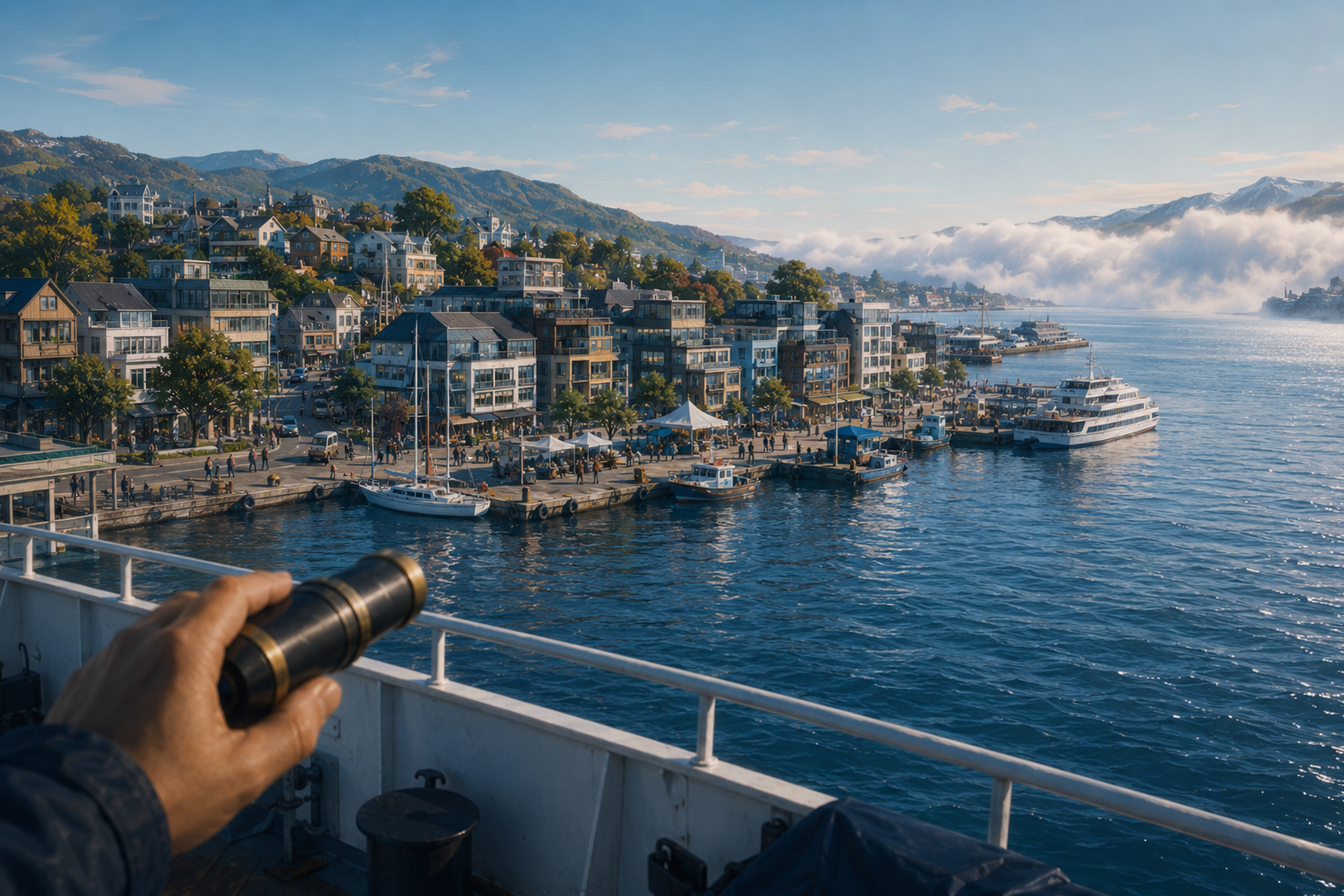
The Navigator found a harbour along the coast.
The entrance was still visible.
Beyond it, nothing.
They turned in.
By noon, the Expedition ship was tied up.
The harbourmaster told them that something the crew had asked for was waiting in a town across the bay.
The Observer volunteered to collect it.
The harbourmaster pointed towards a low silver ferry coming through the fog.
“Forty minutes each way.”
She put the collection note in her coat pocket and walked towards the ferry.
DAY ONE
The ferry was almost full.
She found the last seat beside a window.
A family squeezed bags beneath their feet.
Two people stood in the aisle.
A man beside her shifted his coat onto his knees so she could sit.
“Lucky,” he said.
The Observer looked around.
“Doesn’t feel lucky.”
He smiled.
“No. But the ferry company will be happy.”
“Why?”
“Every seat filled.”
He nodded towards the people standing.
“Probably more than every seat.”
The Observer looked at him.
“That makes it a good crossing?”
“For them, yes.”
“How?”
He shrugged.
“Cost per passenger-seat-mile. The fuller the ferry, the better the numbers look.”
The ferry pulled away.
The Observer watched the harbour disappear into white.
The crossing was noisy.
Someone's phone rang repeatedly.
A child kicked the back of her seat.
When the ferry rolled, shoulders met.
The man beside her tried to open his newspaper, gave up, folded it in half and put it away.
The Observer looked at him.
“And you?”
“What about me?”
“Are you happy every seat is filled?”
He laughed.
“I’d be happier if the one beside me were empty.”
The line stayed with her.
At the far side, nearly everyone stood before the doors opened.
As they stepped onto the quay, the man looked back at the packed cabin.
“Good trip for them.”
Then he disappeared into the crowd.
The Observer went to collect what the Expedition had come for.
The errand took only a few minutes.
Then she returned to the terminal.
The same ferry was waiting.
This time, hardly anyone boarded.
She chose a seat by the window.
Then changed her mind and took one farther forward.
No bags under her feet.
No elbows.
No child kicking the seat.
No one standing.
When the ferry rolled, there was room to move.
The trip back was quiet.
She took out her notebook.
Then put it away.
For once, she simply enjoyed the journey.
Near the harbour, a crew member walked through the cabin.
The Observer looked around.
“This one feels better.”
The crew member sighed.
“Terrible crossing.”
She laughed.
He did not.
“Why?”
“Empty.”
He looked across the rows of vacant seats.
“Cost per passenger-seat-mile is awful on a trip like this.”
The Observer looked at the rows of vacant seats.
The man from the outbound trip had said the ferry company would be happy when every seat was filled.
Now the ferry company was unhappy because almost none were.
The same KPI that improved as more seats were filled moved in the opposite direction from her own experience.
For the operator, the empty seats were waste.
For her, they were space.
Choice.
Calm.
A better journey.
The same ferry.
The same route.
The same day.
The trip that had been better for the operator had been worse for her.
The trip that had been better for her had been worse for the operator.
Back aboard, the crew barely noticed what she had collected.
The Observer was still looking towards the ferry.
The Captain noticed.
“Good trip?”
The Observer considered it.
“I’m not sure.”
At supper, she told them about the passenger.
“He said the ferry company would be happy because every seat was filled.”
The Scout looked at her.
“Was he happy?”
“No. He wanted the seat beside him empty.”
“And on the way back?”
“The ferry was almost empty.”
“So you were happy.”
“Yes.”
“And the ferry company?”
“Terrible crossing.”
“Why?”
“Cost per passenger-seat-mile.”
The Scout stopped smiling.
The Observer looked around the table.
“Their KPI improved as my journey got worse.”
The Captain leaned forward.
“And got worse as your journey got better.”
The Engineer put down his fork.
“So the number can improve while the customer experience deteriorates.”
“Yes.”
The Navigator looked back towards the ferry.
“And that cannot be the only measure that does it.”
They began naming others.
More seats could improve capacity while leaving less room for luggage.
Less space per passenger could improve density while making a long journey worse.
Faster boarding could improve turnaround while making the experience harder for people who needed more time.
Tighter capacity could improve efficiency while leaving less resilience when something went wrong.
The Captain looked at the list.
“So the discovery is not about one KPI.”
The Observer nodded.
“It is about what happens when the measure becomes the definition of good.”
The Scout looked towards the ferry outside.
“So the best crossing was the worst crossing.”
“For me.”
“And the worst crossing was the best crossing.”
“For them.”
The Engineer kept eating.
“They need passengers.”
“Yes.”
“An empty ferry loses money.”
“Yes.”
“So what made no sense?”
The Observer looked at him.
“That we can describe the same crossing as better and worse without either of us being wrong.”
The Engineer put down his fork.
The Captain leaned forward.
“What would the operator have to believe for the full crossing to be better?”
The Navigator answered first.
“That unused capacity is waste.”
“And you?” the Captain asked the Observer.
“What would you have to believe for the empty crossing to be better?”
“That unused capacity can have value.”
The Scout looked between them.
“Same empty seat.”
“Different meaning,” said the Observer.
The Captain pulled a clean sheet of paper towards the middle of the table.
On the left she wrote:
WHAT DO WE BELIEVE MUST BE TRUE?
On the right:
WHAT DOES SOMEONE OUTSIDE SEE DIFFERENTLY?
The Engineer looked at the two columns.
“The ferry operator isn’t outside his ferry.”
“No,” said the Observer.
“But I was outside his way of judging it.”
The Navigator looked at the page.
“So the strange thing isn’t the empty seat.”
“No.”
“It’s the belief underneath what makes the empty seat good or bad.”
The Observer nodded.
The Captain wrote the first pair.
THE TRADITIONAL VIEW IS THAT HIGHER UTILISATION AND DENSITY ARE INHERENTLY BETTER BECAUSE THEY LOWER UNIT COSTS AND UNUSED CAPACITY OR SPACE IS WASTE.
Beside it:
YET THE SAME OPERATING KPIs CAN IMPROVE WHILE CUSTOMER VALUE GETS WORSE, BECAUSE USERS MAY VALUE THE VERY THINGS THE SYSTEM COUNTS AS WASTE: SPACE, LUGGAGE ROOM, CHOICE, TIME, BUFFER CAPACITY AND RESILIENCE.
The Scout read both.
“So which one do we keep?”
“Both,” said the Captain.
The Scout frowned.
“That seems indecisive.”
“It is a Discovery, not a verdict.”
The Observer looked at the two statements.
The interesting part was not that one was right and the other wrong.
It was that the first had felt like common sense until the second made it visible as a choice.
The Engineer leaned back.
“That happens everywhere.”
The Observer looked at him.
“What does?”
“Things that make perfect sense because everyone has agreed what good looks like.”
The Navigator unfolded one of the old charts.
The earliest lines had been drawn when nobody knew what the Railway would become.
Later maps became more accurate.
Then precise.
Eventually the lines stopped being guesses about where people might go.
They became descriptions of where people could go.
“What if some of our thinking is like this?”
“Old charts?” asked the Scout.
“Not wrong,” said the Navigator.
“Drawn for the world somebody knew at the time.”
The Engineer thought about procedures.
A good answer could become a standard.
A standard could become a habit.
A habit could become a belief.
And a belief could survive long after everyone had forgotten why it began.
The Observer looked at the sheet.
“There is a word for these.”
Not mistakes.
Not stupid rules.
Traditional beliefs about what was right, wrong, normal or required to succeed in a Domain.
Beliefs so familiar that insiders stopped recognising them as beliefs.
She wrote:
DOMAIN ORTHODOXIES
The Scout read it.
“So tomorrow we find things the Railway is wrong about.”
“No,” said the Captain.
The Engineer pointed at the ferry pair.
“The strange thing is only the clue.”
The Observer tapped the left column.
“We need the traditional belief that makes something make perfect sense from inside.”
Then the right.
“And the outside, opposite or alternative view that makes the belief visible as a choice instead of a law.”
The Captain looked at the blank space below the first pair.
“Then we need Assignments.”
They began on one shared sheet.
The first question was about the people who shaped the Domain.
The Observer wrote:
DO01 · STAKEHOLDERS
Who are the Stakeholders?
Who holds power?
How do they play the Domain game?
The Navigator added:
DO02 · VALUE CHAIN
How does value move through the Domain?
Who controls what?
What does the current system assume must happen?
The Scout took the pen.
DO03 · DOMAIN MATURITY
How does our Domain compare with one that moves much faster?
What looks normal to us only because we live inside it?
The Engineer wrote:
DO04 · THE JOB
What is the Domain really here to do?
What does defining the job this way prevent us from doing?
The list grew.
DO05 · INDUSTRY TURNAROUND
How long would it take to reconfigure the Domain completely?
What if the current system disappeared overnight?
DO06 · DOMAIN BLIND SPOTS
What would a Stakeholder never say?
What belief makes the statement feel impossible?
DO07 · KEY PERFORMANCE INDICATORS
What do we measure?
What do those measures teach everyone to want?
What would users say about the same measures?
DO08 · IN DENIAL
Which familiar defensive statements keep the Domain inside its existing logic?
DO09 · NEW HIRES
What would someone arriving from a fast-moving industry find strange?
DO10 · EXPERTS
What would a recognised expert say makes our Mandate / Challenge impossible?
Which beliefs sit underneath those reasons?
DO11 · UNSOLVED
Why has nobody already solved our Mandate / Challenge?
Which orthodoxies keep those reasons in place?
DO12 · BLOCK
What external factor could stop us?
What would have to become true for us to succeed anyway?
DO13 · ONE THING
What does everyone know must happen for us to succeed?
Why has it not happened?
DO14 · STUPID
What does a customer think the Domain does that is stupid?
Why do they think we keep doing it?
Finally:
DO15 · DEVIL’S ADVOCATE PANEL
Let traditional Stakeholders explain why their role and beliefs make sense.
Then challenge those beliefs together.
The Scout added one more line.
DOXX · WILDCARD
The Captain looked at him.
“What does that one ask?”
The Scout wrote:
THE TRADITIONAL VIEW IS THAT...
Then:
YET SOMEONE OUTSIDE MAY SEE...
“Whatever the other Assignments missed.”
The Engineer counted.
“Fifteen.”
“Sixteen with the Wildcard,” said the Scout.
The Observer looked at the sheet.
“One ferry trip created all of that?”
“No,” said the Captain.
She pointed towards the harbour.
“The ferry gave us the lens.”
Then she touched the Assignment list.
“These give us different places to look.”
The experience had exposed one hidden belief.
The Assignments would search for more.
Some would use real outsiders.
Some would use Stakeholders inside the Domain.
Some would ask the crew to borrow a different perspective.
Some would compare the Railway with another Domain.
Some would produce several Discoveries.
Some might produce none.
The purpose was not to attack the Railway.
It was to make inherited beliefs visible.
The Observer looked at the page.
“We need these ashore tomorrow.”
The Engineer found the same stack of small field cards they had used at the last port.
They copied one Assignment onto each card.
Title on the front.
The central question beneath it.
On the back of every card they added the same two prompts:
WHAT MUST INSIDERS BELIEVE FOR THIS TO MAKE SENSE?
WHAT DOES SOMEONE OUTSIDE, OR THE OPPOSITE VIEW, SEE DIFFERENTLY?
By the time they finished, the full Domain Orthodoxies deck lay across the table.
The Captain looked at it.
“Bring back the belief.”
The Observer added:
“And what makes it less inevitable.”
Outside, the harbour entrance remained white.
DAY TWO
By breakfast, the fog still closed the way out.
They met on deck.
The Flag moved lightly above them.
The Captain looked at it.
Then the Spyglass.
Then the Treasure chest.
Then the Assignment cards.
“Same Flag. Same line of sight. Same Treasure. New Assignments.”
They worked in buddy pairs, changing partners and cards through the day.
Every Assignment would be worked.
Not every Assignment would earn a full story.
Some required conversations.
Some observation.
Some reconstruction of how the Railway actually worked.
Some borrowed perspectives.
Some comparisons with other Domains.
Some produced almost nothing.
That was allowed.
The purpose was not to prove the Railway wrong.
It was to expose beliefs that looked inevitable from inside and less inevitable from somewhere else.
DO04 · THE JOB
The Navigator and Observer began with the Railway station.
“What is its main job?”
“To move people to and from trains.”
The answer arrived too quickly.
That made it interesting.
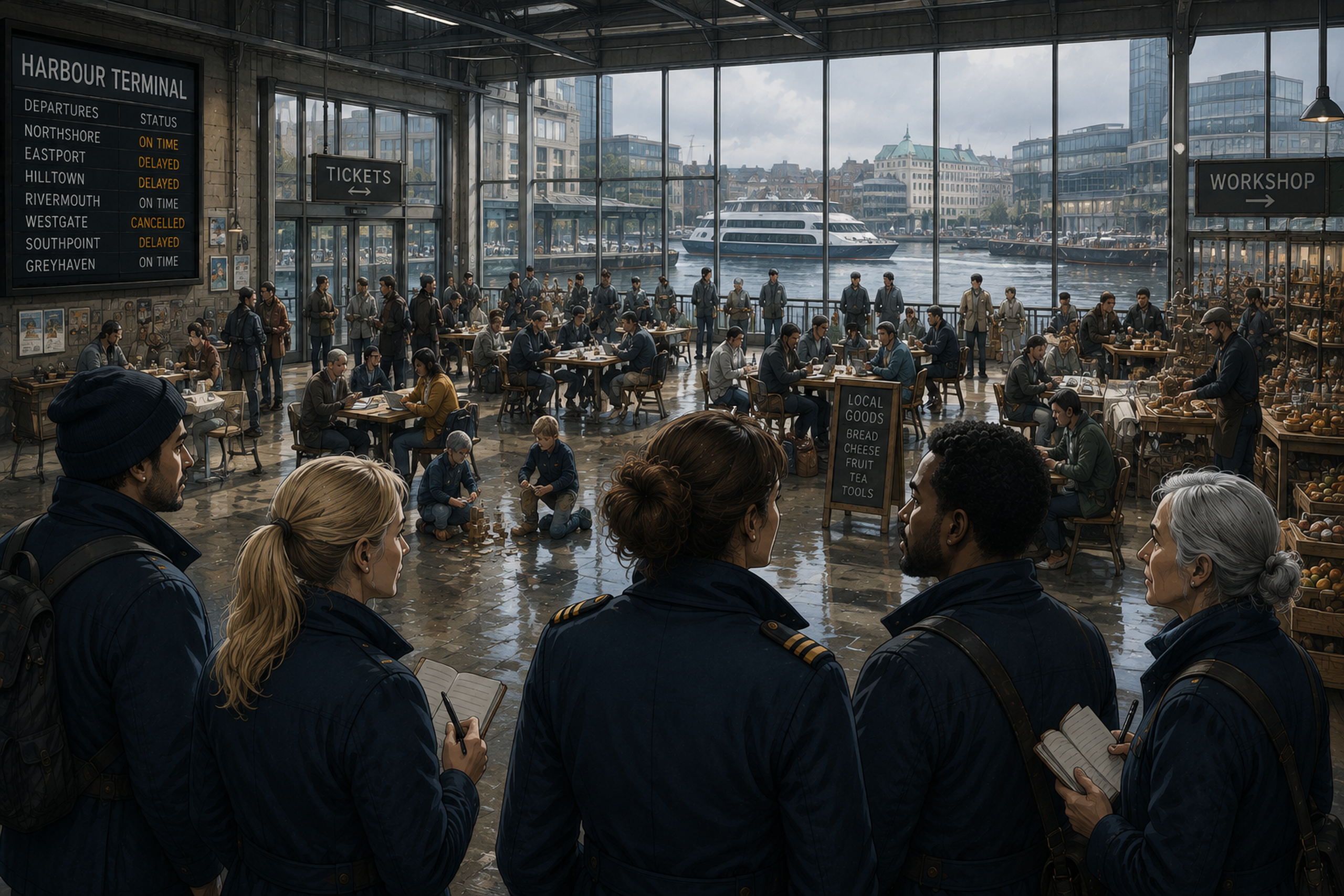
They walked through the harbour terminal from the day before.
People were meeting.
Working.
Eating.
Trading.
Waiting.
Some were travelling.
Some were not.
They asked people what the place was for.
The answers varied.
Transport.
Meeting.
Shopping.
Waiting.
Shelter.
Orientation.
A known place in town.
The Navigator wrote the first half:
THE TRADITIONAL VIEW IS THAT A STATION’S PRIMARY JOB IS TO MOVE PEOPLE TO AND FROM TRAINS.
The Observer added the view from outside that job definition:
YET OUTSIDERS MAY VALUE A STATION AS A PLACE, MEETING POINT, MARKET OR PIECE OF CIVIC INFRASTRUCTURE EVEN WHEN NO TRAIN IS INVOLVED.
The Navigator looked at the pair.
“So which is the real job?”
“Later,” said the Observer.
The Assignment was not asking them to redesign stations.
It was asking them to see that the inherited definition of the job was not the only possible one.
DO07 · KEY PERFORMANCE INDICATORS
The Captain and Scout worked with familiar Railway measures.
Punctuality.
Reliability.
Capacity.
Cost.
Utilisation.
Safety.
The fast ferry had already given them one candidate belief.
Now they tested whether it travelled.
For a train already running, more seats occupied across more of the journey meant more passenger-seat-miles carried by the same movement.
Lower cost per passenger-seat-mile.
Useful.
Logical.
But the ferry had taught them not to stop at one measure.
They listed other things the Railway could improve:
more seats per carriage,
less floor space left unused,
faster boarding,
higher load factors,
less buffer capacity,
less room given over to luggage.
Each could improve an operating number.
Each could also remove something a passenger valued.
The Captain wrote:
THE TRADITIONAL VIEW IS THAT HIGHER UTILISATION AND DENSITY ARE INHERENTLY BETTER BECAUSE THEY LOWER UNIT COSTS AND UNUSED CAPACITY OR SPACE IS WASTE.
The Scout turned the card over.
“What does someone outside see?”
They borrowed the passenger’s position.
What did a completely full carriage feel like?
Less room.
Less choice.
Less possibility of working.
More noise.
Less luggage space.
Less resilience when something went wrong.
What did a faster boarding process feel like to someone travelling with children, a wheelchair or several bags?
What did another row of seats mean if it removed somewhere to put what passengers brought with them?
They tested the thought with travellers passing through the port.
Nobody argued for empty trains.
That was not the point.
One man looked at the card and said:
“You measure the seat. I live in it.”
The Scout wrote the second half:
YET THE SAME OPERATING KPIs CAN IMPROVE WHILE CUSTOMER VALUE GETS WORSE, BECAUSE USERS MAY VALUE THE VERY THINGS THE SYSTEM COUNTS AS WASTE: SPACE, LUGGAGE ROOM, CHOICE, TIME, BUFFER CAPACITY AND RESILIENCE.
The measures were not wrong.
The discovery was that an operating KPI could reward exactly the condition a customer experienced as worse.
The Orthodoxy appeared when the measure stopped being one view of performance and became the definition of what good meant.
DO09 · NEW HIRES
The Engineer and Scout borrowed the eyes of somebody entering the Railway from a fast-moving technology company.
“What would look strange?”
“Approvals,” said the Scout.
“That is not strange. It is safe.”
“Exactly what the new hire would hear.”
The Engineer glared at him.
They followed the thought.
Some decisions genuinely required consistency across the entire system.
Others moved upward because that was how important exceptions had come to be treated.
They tested the idea with a founder introduced by the harbour operator.
The Engineer defended the Railway before the man had finished asking the question.
Safety mattered.
Consistency mattered.
Millions of people depended on the system behaving predictably.
“You cannot let everyone improvise everything.”
The founder agreed.
Then asked:
“Did I say you should?”
The Engineer stopped.
“Why is the choice always central control or chaos?”
Some things had to be identical everywhere.
Others became worse because the people closest to the situation had no room to act.
Back aboard, they wrote:
THE TRADITIONAL VIEW IS THAT IMPORTANT EXCEPTIONS SHOULD MOVE UPWARD FOR APPROVAL BECAUSE CONSISTENCY AND SAFETY REQUIRE CENTRAL CONTROL.
Then:
YET OUTSIDERS MAY SEE SOME RELIABILITY AS COMING FROM GIVING CLEAR BOUNDARIES AND MORE AUTHORITY TO THE PEOPLE CLOSEST TO THE PROBLEM.
Not anti-control.
Not pro-chaos.
A traditional belief beside another way of seeing reliability.
DO14 · STUPID
The Scout enjoyed this Assignment too much.
They found a customer who used the Railway regularly.
“What does the Railway do that is stupid?”
The customer laughed.
“Everything?”
“Pick one.”
He thought.
“You own useful things and then insist they only be useful to the Railway.”
The Scout looked at the Engineer.
The Engineer ignored him.
They kept asking why.
Land.
Buildings.
Rights.
Relationships.
Technical knowledge.
Data.
Trust.
National presence.
People who knew how to build.
People who could operate complicated systems.
Places where large numbers of people repeatedly appeared.
The customer did not see those things only through the purpose that had produced them.
The Railway usually did.
The pair wrote:
THE TRADITIONAL VIEW IS THAT RAILWAY LAND, BUILDINGS AND CAPABILITIES SHOULD BE USED TO SUPPORT THE RAILWAY BECAUSE THAT IS WHAT THEY EXIST FOR.
Then:
YET OUTSIDERS MAY SEE THE SAME ASSETS AS PLACES, ACCESS, CAPABILITIES AND RELATIONSHIPS THAT CAN CREATE VALUE FAR BEYOND TRAINS.
The Engineer read it.
“That one I dislike.”
The Scout smiled.
“Good sign?”
“No.”
“Still useful.”
“Unfortunately.”
THE OTHER ASSIGNMENTS
Those four took most of the telling.
They were not the only Assignments the crew worked.
Every card was used.
STAKEHOLDERS exposed beliefs about who was entitled to decide and whose interests carried the most weight.
VALUE CHAIN exposed assumptions about where value was created, who should control it and why the sequence had to work as it did.
DOMAIN MATURITY made the Railway look different beside industries that changed their products, channels and business models far more quickly.
INDUSTRY TURNAROUND exposed which parts of the system people treated as immovable, even when asked to imagine the entire system disappearing overnight.
DOMAIN BLIND SPOTS produced statements Stakeholders found almost impossible to say, then forced the crew to ask why.
IN DENIAL surfaced familiar defensive logic that sounded sensible precisely because everyone had heard it before.
EXPERTS exposed beliefs hidden inside reasons the Mandate / Challenge was supposedly impossible.
UNSOLVED revealed that several barriers were also assumptions about how the Domain had to operate.
BLOCK made the crew separate genuinely external constraints from constraints people had simply stopped imagining around.
ONE THING exposed beliefs that survived partly because everyone repeated them.
DEVIL’S ADVOCATE PANEL took longest. Traditional Stakeholders first explained why their roles and beliefs made sense. Then the same group tried to overturn them.
And whenever the fixed deck itself started to feel like an orthodoxy, they used:
DOXX · WILDCARD
Some Assignments produced strong pairs immediately.
Others produced only observations.
Some exposed a traditional belief but no credible outside or opposite view.
Those stayed incomplete.
A complaint was not enough.
A strange practice was not enough.
Even an Orthodoxy alone was not enough.
The crew wanted the tension:
WHAT INSIDERS TAKE FOR GRANTED
beside
WHAT SOMEONE OUTSIDE, OR THE OPPOSITE VIEW, MAKES POSSIBLE TO SEE.
By late afternoon, the second wall was filling.
DOMAIN ORTHODOXY DISCOVERIES
Each Discovery carried both sides.
Not a verdict.
Not a recommendation.
Not yet an Insight.
The traditional view.
And the view that made it visible as a choice rather than a law.
The longer they worked, the easier some patterns became to see.
Different Assignments returned to the same belief.
Different people challenged it in different words.
A New Hire and a customer exposed the same assumption.
A KPI and a Value Chain question pointed towards the same definition of success.
A Stakeholder defended a rule that another Assignment had already surfaced.
New evidence kept arriving.
New Orthodoxy territory became harder to find.
The Scout brought back another note about waiting.
The Observer read it.
“New belief?”
He looked at the wall.
“No.”
“New outside view?”
He checked again.
“No.”
“Then add it to the one we have.”
The Captain watched the wall fill with support rather than new headings.
They had worked every Assignment.
The Wildcard had pushed beyond the fixed deck.
There were still more people they could ask.
There always would be.
But the last pages increasingly changed the examples rather than the Discovery landscape.
The Captain looked at the fast-ferry card from the day before.
One experience had shown them where to look.
The Assignments had made the search deliberate.
Now the search was returning them to territory they already knew.
“Enough for this port?” asked the Navigator.
The Engineer looked across the wall of Discoveries.
“We know how to tell what needs questioning.”
The Captain nodded.
“Freeze the collection.”
They kept:
the traditional belief,
the outside or opposite view,
the observations,
the sources,
the examples,
and the questions still unresolved.
They did not decide which Orthodoxy should be overturned.
They did not design replacements.
They did not ask how to exploit them.
They did not test Remarkable.
They did not test Actionable.
They did not test Provocative.
Those steps belonged later.
For now, they had learned how to see the old charts.
DAY THREE
When they woke, the breakwater had edges again.
Beyond it lay a strip of clear water.
The Navigator checked it against the chart.
The fog had not gone.
It had moved far enough to give them passage.
Before they cast off, the five stood beneath the two walls of Discoveries.
Other people had seen things the crew no longer saw.
They valued things the Railway treated as ordinary.
They questioned things the Railway treated as inevitable.
And the crew had learned something more precise.
A strange practice was only the beginning.
The real Discovery sat underneath it.
What must we believe for this to make perfect sense?
And beside that:
What does someone outside see differently?
One wall held what outsiders valued in the Railway.
UNFAIR ADVANTAGES
The other held traditional beliefs beside the outside or opposite views that made them visible.
DOMAIN ORTHODOXIES
Familiarity had hidden both.
Distance had made both visible.
The ferry had not changed.
The terminal had not changed.
What had changed was what they could see in them.
The Observer looked towards the town across the harbour.
People moved through streets, shops, homes and workplaces.
Their own systems.
Their own workarounds.
Their own lives.
She picked up the Spyglass.
Then pointed it away from the Railway.
“Maybe it’s time we looked the other way.”
The Captain took it.
She raised it towards the harbour entrance.
No destination showed through the Spyglass.
Only enough water to leave.
“We sail while we can.”
The Navigator nodded and went to the lines.
They cast off.
The Observer kept looking towards the lives along the shore.