PART II / CHAPTER 8 / PIRATES
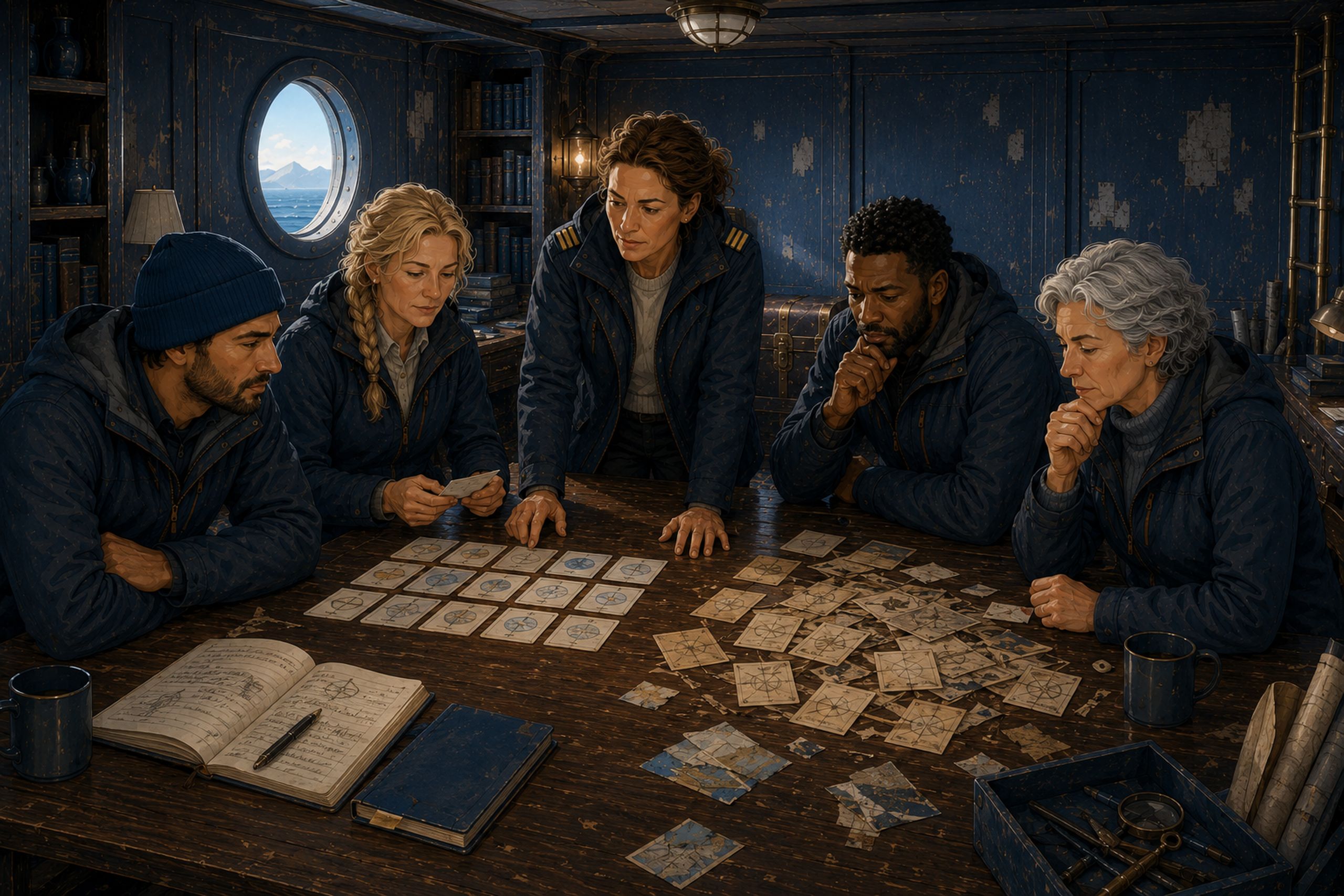
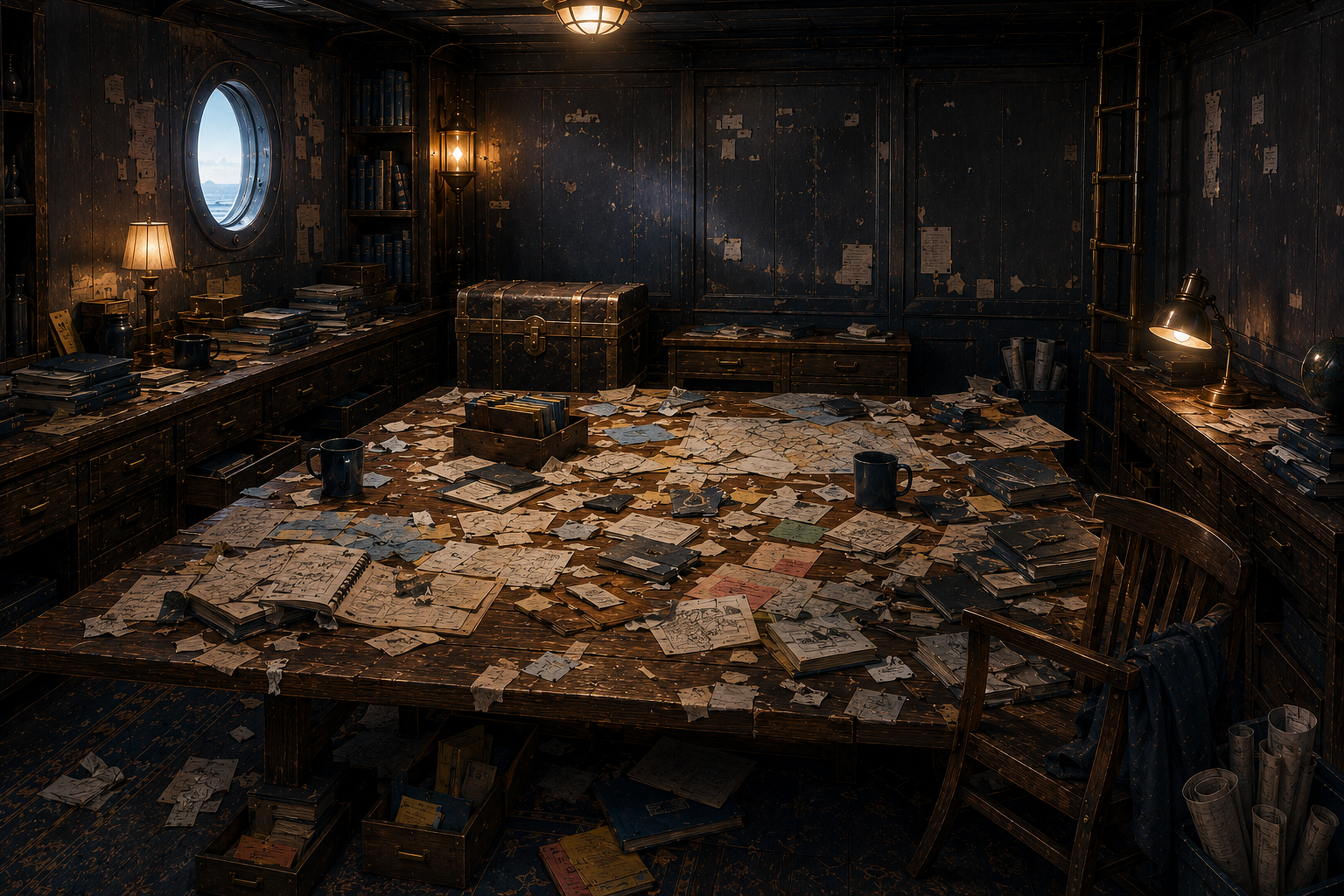
The Engineer found the chart room door open before breakfast. That was unusual. He stepped inside. Then stopped. The room was not empty. Worse. Selective. Some qualified Insights remained. Others were gone. The selection had not been tidy. Papers lay across the table and floor. A chair stood out from where they had left it. The boards were largely bare, with a few torn corners and fragments still clinging where material had been pulled away. But nothing else had been taken. Maps. Notebooks. Spyglass. Treasure chest. Even the pencils beside the window. Only Insights were missing.
The ones left behind had been pulled together into one deliberate pile amid the disorder. The Engineer went on deck.
“Captain.”
Something in his voice brought everyone quickly. The Scout reached the chart room first.
“Oh.”
The Navigator checked the hull. Fresh marks along one side. Another vessel had been alongside. The Scout looked towards the horizon.
“Pirates.”
The Engineer stared at him.
“You sound pleased.”
“I’m not pleased.”
“You’re smiling.”
“I’ve never been robbed by pirates before.”
The Captain looked at the room.
“They weren’t here for the ship.”
That stopped him. No equipment. No supplies. No money. No food. Some Insights. The Observer found a note on the pile they had left.
THANK YOU FOR THE KEYS.
YOU CAN KEEP THE REST.
The Scout stopped smiling. Keys. Not Insights. And the rest had not been missed. Someone had examined everything. Chosen. Taken some. Deliberately left others. The Engineer opened the Expedition Record.
“We can rebuild them.”
The Scout looked at him.
“All of them?”
“Everything.”
By breakfast, the first stolen Insight existed again.
Then another.
The Navigator checked wording. The Observer checked the route beneath each. Complete Industry Disruptor cards were reconstructed with their names, three Disruption Formulas and descriptions intact. The pirates had stolen cards. Not knowledge. By mid-morning, the table held two groups. Recreated stolen Insights. And the ones the pirates had left. The Scout leaned back.
“So we were robbed and lost nothing.”
The Captain looked at the two piles.
“No.”
He turned.
“We gained something.”
Nobody understood. She pointed at the stolen group.
“Someone outside the Railway looked at our qualified Insights and chose.”
The Navigator saw it.
“Why these?”
Exactly.
The interesting question was no longer who the pirates were. It was:
WHY WERE THESE WORTH STEALING?
The crew began trying to see the material as someone else might. Every qualified Insight entered the relay intact. A provocative title and its description travelled together. A complete Industry Disruptor travelled as a whole card, with all three Disruption Formulas and their descriptions intact. Nobody rewrote, sharpened, combined or requalified anything. Each pirate could make only one decision: KEEP or PASS.
The Scout looked at the stolen group.
“What if someone wanted to start something new?” asked the Scout.
“Against us?” said the Engineer.
“Why not?”
“A Startup Attacker,” said the Captain.
The Navigator looked at the card.
“Who else might want it?”
“What if they weren’t building anything themselves?” asked the Navigator. “What if they were deciding what was worth backing?”
“An Investor,” said the Observer.
The Captain looked towards the other pile.
“And what if they already competed with us?”
“Our fiercest competitor,” said the Engineer. “What would they want us to leave behind?”
The Observer drew three columns.
STARTUP ATTACKER.
INVESTOR.
FIERCEST COMPETITOR.
“We don’t know who came aboard,” she said. “But we can look through each of these eyes.”
The Scout pulled the first card towards him.
“I’ll start something new.”
“One role at a time,” said the Captain. “If you pass, the next takes a look. If you keep it, we know someone sees enough value to steal it.”
The first card was an Unfair Advantage.
THE DEED CHANGES HANDS. THE PHONE STILL RINGS FOR US.
The Railway's advantage is not only the land or stations it owns. Generations of local presence have created relationships, trust and permission that remain difficult to buy or copy. A competitor can acquire property, technology and talent far faster than it can acquire the legitimacy that makes landowners, businesses, municipalities and communities answer the Railway's call.
The Scout asked:
“Who would want this?”
“A Fund,” said the Engineer.
“Why?”
“It can buy land. Companies. Technology. Talent. Advisers.”
He tapped the card.
“But not history.”
The Observer nodded.
“Not the reason people answer the call.”
The exact future did not matter yet. Another intelligent actor could already see the building material. The Startup Attacker wrote KEEP. Scrutiny ended for that card.
The next card was a Pain & Priority.
IF I NEED A BACKUP PLAN BEFORE I BOARD, THE SERVICE ISN'T REALLY CERTAIN.
People repeatedly accept spare capacity, extra cost, slower delivery, early departure and waiting when those sacrifices protect a reliable outcome. The visible complaint may be speed, capacity or inconvenience, but behaviour shows the deeper Priority: knowing that the thing they depend on will happen when it needs to.
The Startup Attacker could not see enough to steal. PASS. The card moved intact to the Investor, who recognised the price people already paid for certainty. KEEP. Scrutiny ended.
Then came a Domain Orthodoxy.
EVERY RISK HAS AN OWNER. THE DECISION NEEDS ONE TOO.
Central approval can create consistency and safety where uniformity matters. But when important exceptions always move upward, people closest to the situation can be left waiting even where local judgement would improve the outcome. The orthodoxy is not that control is wrong, but that escalation is automatically safer than explicit decision ownership at the right level.
Startup Attacker: PASS. Investor: PASS. Fiercest Competitor: KEEP. The card had travelled unchanged through the relay until someone outside the Railway's loyalties recognised what it could enable.
Complete Industry Disruptor cards entered under the same relay rule but kept their different anatomy. No pirate extracted one formula, translated it into Railway language or turned it into a new card. They examined the name, all three Disruption Formulas and their descriptions, then chose KEEP or PASS. A card passed by all three pirates would reach the Last Advocate whole.
By lunch, the crew understood the pirates as three deliberate positions rather than one specific competitor. Startup Attacker. Investor. Fiercest Competitor. Each looked at the same intact card without loyalty to the Railway’s existing shape. The pirates had one advantage the crew did not. They owed the Railway nothing.
They did not care how hard an Insight had been to find. They did not care whether it fitted the current business. They cared whether they could create value from it. The Engineer looked at the stolen group.
“So these stay.”
The Scout raised an eyebrow.
“Automatically?”
“Someone outside us thought they were worth taking.”
The Observer added:
“And believed they could do something with them.”
Perhaps beside the Railway. Around it. Against it. Maybe better than it. The exact answer did not matter. Another intelligent actor had recognised building material. The Captain looked at the stolen pile.
“If someone else can see enough value here to steal these, we’d be foolish to leave them behind.”
Then the Observer turned towards the other pile. The pirate note still sat on top.
YOU CAN KEEP THE REST.
There were more Insights there than in the stolen group. Every one had survived the right qualification path. Unfair Advantages, Pains & Priorities and Domain Orthodoxies had moved through Remarkable, Actionable and Provocative. Industry Disruptors carried the Disruption Formulas identified from their winner stories as whole cards. Their wording and anatomy remained unchanged through scrutiny. And someone outside the Railway had examined each card and left it. The Scout picked one up.
“So these are scraps.”
“To the pirates,” said the Observer.
Perhaps the pirates had misunderstood them. Perhaps the Insights did not suit whatever they were trying to build. Perhaps they had missed something. Or perhaps there simply was not enough value there. The uncomfortable question became unavoidable.
IF NOBODY OUTSIDE US WANTED THESE, WHY SHOULD WE?
The Scout picked up one.
“I can tell you why I like this.”
“You found it,” said the Observer.
“So?”
“Exactly.”
“We need somebody who doesn’t own it.”
The untouched Insights did not need another attack. The pirates had supplied that. They needed the opposite. One final serious attempt to show why leaving an Insight behind would cost the Railway something important. The Observer looked at the pile.
“One Last Advocate.”
The name held. The Scout turned over the pirate note. Blank.
“They thought they stole our Keys.”
The Engineer looked towards the Record.
“They took copies.”
The Scout smiled.
“Without knowing it.”
The Navigator looked towards the horizon.
“Do we chase them?”
The Captain considered it. Nothing useful was missing.
“No.”
The Scout sighed.
“What do we do?”
She turned towards the Insights the pirates had left.
“We find out whether they left treasure behind by mistake.”