PART II / CHAPTER 9 / ONE LAST ADVOCATE
The pirate note remained on the table.
THANK YOU FOR THE KEYS.
YOU CAN KEEP THE REST.
Across from it sat the reconstructed Insights the pirates had taken. Between them were the ones they had left. Nothing had been lost. But the two groups no longer meant the same thing. The stolen Insights had already attracted an external vote. Someone had looked at them and thought:
I WANT THESE.
The Engineer touched the pile.
“These have made their case.”
The Captain nodded.
“Someone else saw building material.”
The Scout looked at what remained.
“So now we test whether the pirates were wrong.”
“Not exactly,” said the Observer.
“What then?”
“Whether anything they left is still too valuable for us to lose.”
Every untouched Insight had already survived Qualification and then received PASS from Startup Attacker, Investor and Fiercest Competitor. That was the only route into Last Advocate. It applied to every family. A UA, PP or DO arrived with its provocative title and description unchanged. An Industry Disruptor arrived as a whole card, with all three Disruption Formulas and descriptions intact. That was no longer enough. The Observer picked up one.
“Someone who did not find it argues for it.”
The Scout frowned.
“Why not the person who knows it best?”
“Because that person has spent weeks finding reasons to believe in it.”
“One final advocate.”
The Captain placed the first Insight in front of the Engineer.
“You.”
He looked at it.
“I know this one.”
“You argued against it twice.”
“I still don’t like it.”
“Good.”
The Scout smiled.
“This should be entertaining.”
The Captain looked at the Engineer.
“You do not have to like it. Make the strongest credible case for why the Railway should care.”
The Engineer read. He tried building an argument around it. Weak. Then a more elaborate one.
Better. But still not true enough.
Then he stopped.
“No.”
“What?” asked the Scout.
“I’m forcing it.”
He pushed his notes away.
“I can explain why this is a good Insight.”
“Not enough,” said the Captain.
“I can explain why we kept it this far.”
“Still not enough.”
He looked at it again. Then turned it face down.
“I cannot tell you what valuable possibility we become less able to see or build if we leave it behind.”
The first was gone. The next went to the Scout. He began with the story. The Observer stopped him.
“The story is not the argument.”
“It is a very good story.”
“I know.”
He tried again. What would disappear if the Insight did? What future territory might become harder to see? What building material would they lose? Eventually he sighed.
“I still like it.”
“I know,” said the Captain.
“I still think it’s true.”
“I know.”
“But I can’t tell you why we need it.”
He turned it face down. Last Advocate was quieter than Pirates. No raid. No mystery. No threat. Only one person standing between an Insight and the end of its journey. The question settled into a simple form:
IF WE LEAVE THIS BEHIND, WHAT COULD WE FAIL TO SEE, CHALLENGE OR BUILD?
Being true was no longer enough. They needed building material. The Navigator received a Pain & Priority the pirates had left. At first it looked weak. She followed its route back through the Record. The Captain raised a hand.
“Explain.”
“The Pain matters.”
“Yes.”
“Because it preserves the difference between the problem people describe and the Priority their choices reveal.”
The Scout leaned closer.
“What becomes harder to see if we leave it behind?”
“What people will protect when they cannot have everything.”
The Captain nodded.
“Good.”
That was different. The argument held. The Insight stayed face up. The first rescue. Another survived because it exposed a Domain Orthodoxy capable of killing a future before anyone examined it properly. A complete Industry Disruptor would face the same defence as a whole card if it ever received PASS from all three pirates.
Then the Engineer drew an Insight he had disliked since the week they found it. The Scout leaned back.
“Perfect.”
The Engineer ignored him. He began reluctantly. Then found the route. A real constraint the Insight exposed. A possibility the crew might never see if they removed the tension it preserved. He stopped. Looked at the card. Then at the Captain.
“This one stays.”
The Scout stared at him.
“You still hate it?”
“Yes.”
“But you saved it.”
“Also yes.”
Nobody laughed. The Insight remained face up. Another failed because its Advocate had to invent an elaborate future first and then work backwards to make the Insight relevant. The Captain stopped it.
“We are not inventing what Keys can unlock just to save them.”
The Scout smiled.
“Not yet.”
“Exactly.”
Another failed because everything important inside it already survived more strongly elsewhere. Another because the only defence was:
“It might be useful someday.”
One Domain Orthodoxy was beautifully phrased. Sharper than a similar one the pirates had taken. But the stolen Insight carried stronger consequences. The Observer looked at both.
“If this disappears, what do we lose?”
“Another way of saying something we already know.”
She turned it face down.
The table became still. Two groups remained. Insights the pirates had valued enough to steal. And the few Insights a Last Advocate had credibly rescued. The Engineer looked at the first.
“These proved someone else could use them.”
The Observer looked at the second.
“And these proved we would lose something important without them.”
The Captain nodded.
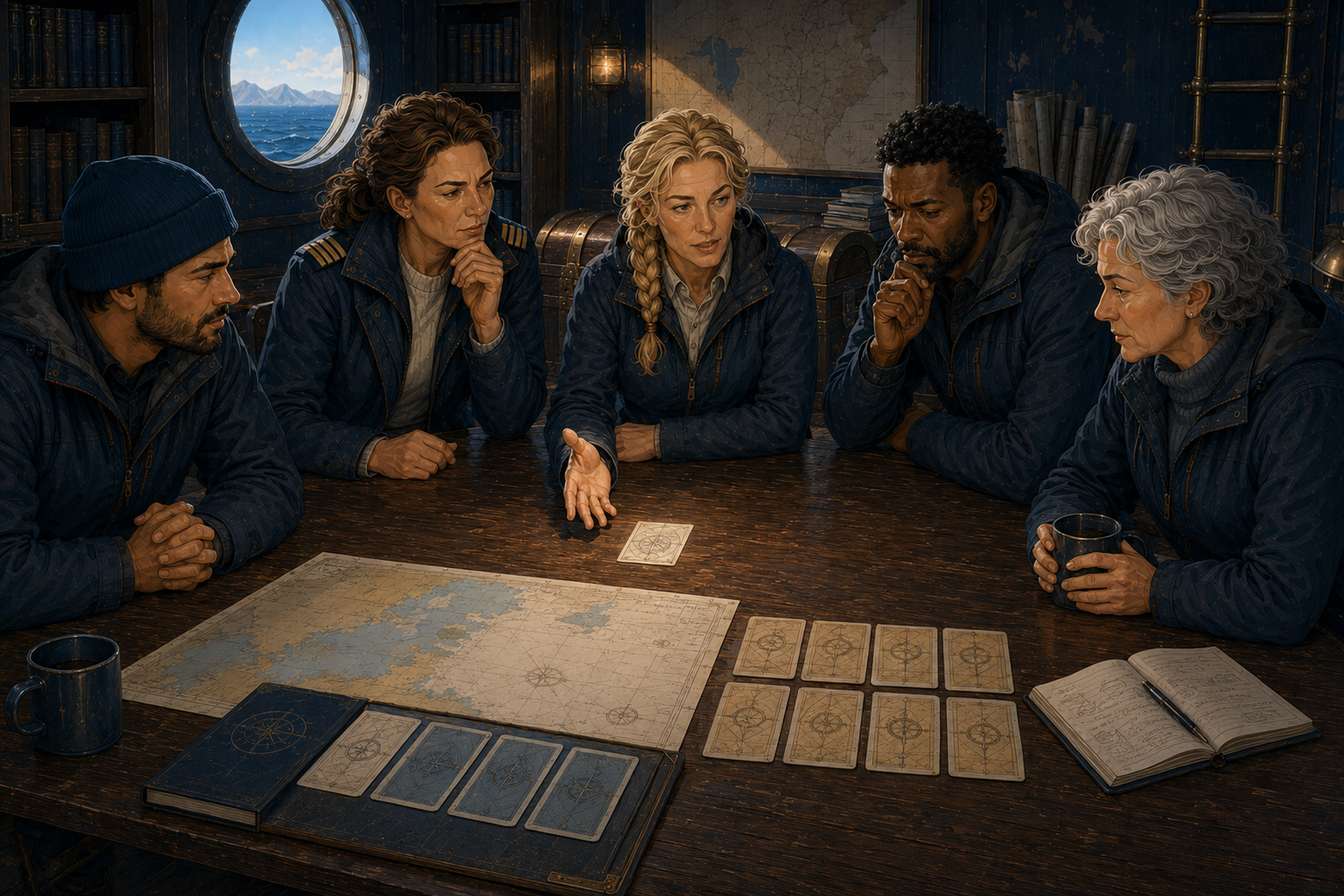
“Now we decide.”
The Scout stared at her.
“Haven’t we decided enough?”
“Not yet.”
“What is left?”
She looked towards the Treasure chest.
“Commitment.”
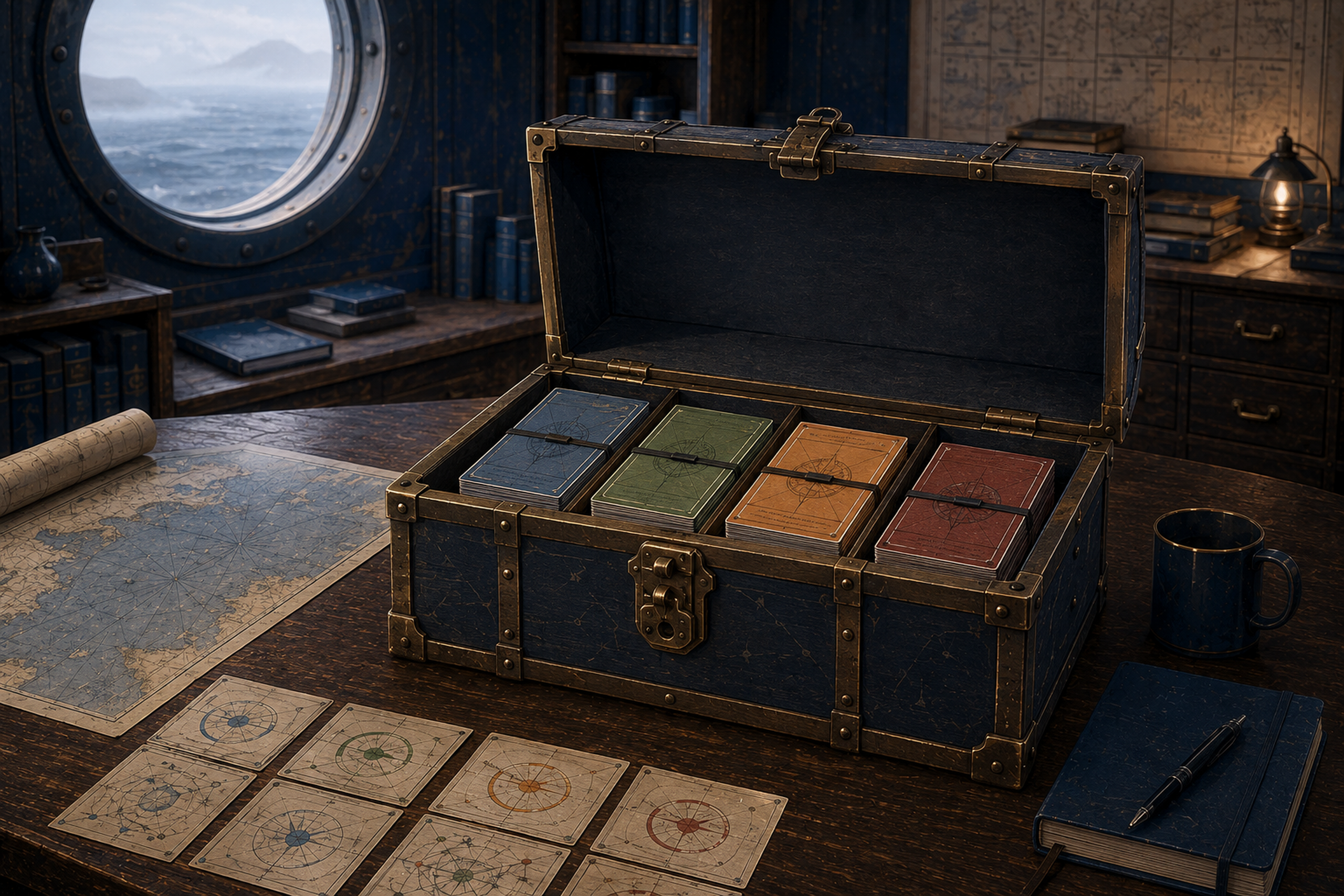
The chest had travelled with them since Harbour Station. Still empty. They had found many valuable things. Surprising capabilities. Important Pains. Provocations. Patterns. Disruption Formulas. Possibilities. None had entered. The rule had not changed. Finding something valuable did not make it Treasure. The chest was for what the Expedition deliberately committed to carrying forward.
The Captain moved all surviving Insights into the centre. No longer stolen. No longer rescued. Simply what remained.
“Are these what we are prepared to build from?”
The Engineer looked at the pirate-selected group. Leaving them would mean abandoning material outsiders had already recognised as potentially valuable.
“Yes.”
The Navigator looked at the Last Advocate survivors. Each had survived the harder question of what the Railway would lose without it.
“Yes.”
The Observer looked towards everything that had stopped. Nothing had disappeared. Every reason remained. That made saying yes easier, not harder.
“Yes.”
The Scout looked at the Captain.
“Yes.”
She nodded.
“Then we commit.”
The cards did not change. Their status did. Until then they had been Insights. Qualified findings the Expedition trusted. Now they were the Insights the Railway’s Expedition was deliberately choosing to carry into future-making. At Commitment, the three Discovery families received their permanent public numbers for the first time. Four Unfair Advantages. Four Pains & Priorities. Four Domain Orthodoxies. Four Industry Disruptor Key Insights. UA01 through UA04. PP01 through PP04. DO01 through DO04. ID01 through ID04. Sixteen in the founding set. The Scout looked at them.
“Keys.”
The Captain looked back.
“New Keys.”
The Observer wrote:
KEY INSIGHTS
The Captain opened the Treasure chest. For the first time. One by one, all sixteen committed Key Insights went inside. Unfair Advantages. Pains & Priorities. Domain Orthodoxies. Industry Disruptors, with their complete cases, names and selected Disruption Formulas and descriptions intact. All four families were now Key Insights. The Scout looked into the chest.
“So this is Treasure.”
“For this phase,” said the Captain.
“It isn’t a future.”
“No.”
“Not even an opportunity.”
“No.”
He smiled.
“But they’re Keys.”
“Yes.”
“So what do the Keys unlock?”
The Navigator looked at him, then towards the fog beyond the glass.
“We don’t yet know,” she said.
And now that ignorance meant something different. At the beginning of the Expedition, they had not known because they had not looked. Now they had looked. Broadly enough to trust the picture. They had qualified what survived. They could take every Key backwards. They could account for what had not continued.
Outsiders had selected some. Last Advocates had rescued others. And the crew had committed to build from the final set. The unknown had moved. The Observer made working copies and arranged the Key Insights in four groups.
PAINS & PRIORITIES
What people genuinely struggle with, care about and prioritise enough to act on.
UNFAIR ADVANTAGES
What the Railway already owns, controls, knows, can access or can do unusually well, especially in combinations others cannot easily replicate.
DOMAIN ORTHODOXIES
The accepted assumptions, rules and measures shaping how the Railway understands and operates its domain, and which might need to be challenged or overturned.
INDUSTRY DISRUPTORS
Industry Disruptors from extraordinary winners elsewhere, each together with one, two or all three of its Disruption Formulas and descriptions. Like Domain Orthodoxies, these Key Insights can help create opportunities and qualify opportunities later.
The Scout looked across the four groups.
“Why these four?”
The Engineer touched the Unfair Advantages.
“Because whatever we build must begin with something others cannot easily reproduce.”
“And matter enough for people to change what they do,” said the Navigator.
The Observer rested a hand beside the Domain Orthodoxies.
“And find where an old rule has become an unnecessary boundary.”
“Not every rule,” said the Scout.
“No.”
The Captain looked at the Industry Disruptors.
“And test whether someone else’s way of winning can help us win differently.”
The Scout looked towards the chest.
“So the Keys tell us what future to make?”
“No,” said the Captain. “What a future worth pursuing will have to prove.”
The four groups remained separate. The crew could see relationships between them, but they did not yet follow those relationships or use them to create anything new.
The Captain closed the Treasure chest.
Outside, fog still covered almost everything ahead. The chest held Keys. No destination. No opportunity. No promise of what came next.
KEEP THE KEYS. WE DON’T YET KNOW WHAT THEY CAN UNLOCK.