PROLOGUE / THE RAILWAY
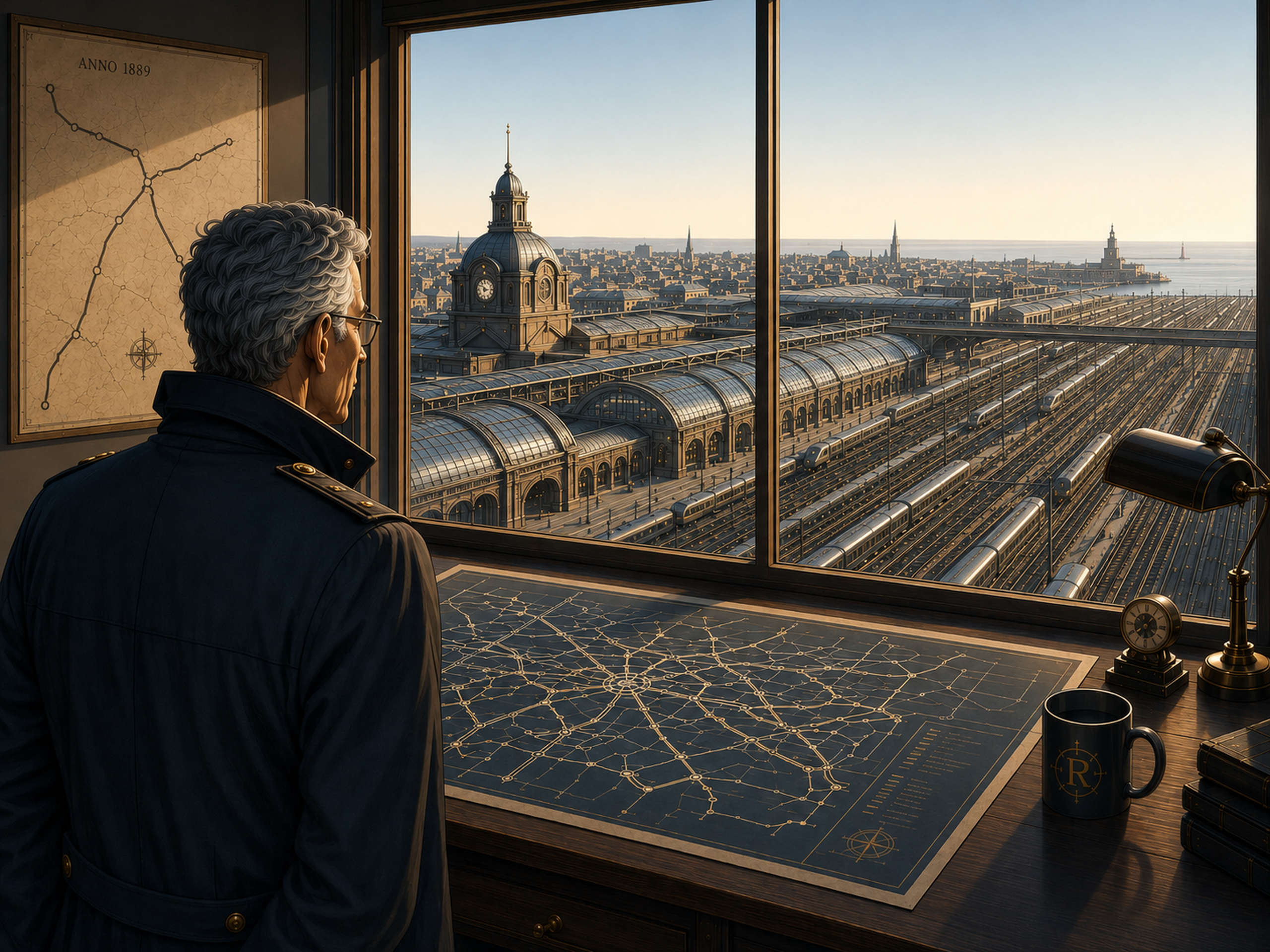
The morning was crisp and bright. Sunlight fell cleanly across Central Station as the 07:42 left within seconds of schedule. The Railmaster watched from the windows above. Seventeen platforms spread beneath him. Signals changed. Doors closed. Hundreds of people moved through a system whose complexity had long ago stopped looking complicated. People sometimes said even the organisation ran on tracks.
The Railmaster considered that about the highest compliment anyone could give it. And the Railway was still getting better. On his desk lay a folded note from the Engineer.
WEST LINE TURNAROUND: POSSIBLE REDUCTION, 96 SECONDS.
Ten years earlier, they had removed eleven minutes from the same journey. Five years later, another four. Last year, forty-two seconds. Now ninety-six seconds had taken six weeks to find. The Railmaster smiled. Ninety-six seconds mattered. Across thousands of journeys, small gains became large ones. Still, he had noticed the pattern.
Each improvement was harder to find. Each yielded a little less. The Railway could run faster. Carry more people. Stop for less time. Use less energy. Arrive more precisely. Recover more quickly when something went wrong. There was always another improvement. But an extraordinary Railway was becoming increasingly difficult to make dramatically more extraordinary.
The Railmaster did not see that as failure. Quite the opposite. The 07:49 was already moving. Every train leaving Central that morning had a destination before it travelled a metre. The 07:42 knew where it would stop. So did the 07:45. So did the 07:49.
Their journeys could become better. The tracks already knew where they could go. The thought made him turn towards the wall opposite his window. Two maps hung there. The larger showed the Railway they had built. Hundreds of stations. Thousands of kilometres of track. Branches, junctions, loops and freight lines crossed the country in a dense web.
Beside it hung one of the oldest maps in the Railway archive. Same country. Almost no Railway. A few dark lines ended abruptly. One at a river. Another in the northern foothills. Large parts of the map were empty. The people who drew those first lines had not known what the Railway would become.
They did not know which towns would grow around their stations. Which businesses their tracks would make possible. How differently people might live once distance changed. They had begun with questions.
Could they cross the river?
Could they get through the mountains? Would anyone use the line if they built it? What happened if they connected places that had never been connected before? There had been no Railway procedure for answering those questions. There was barely a Railway. They tried things. Some worked. Some did not.
They changed course. Built bridges. Invented methods. Learned what the land would allow. The door opened. At 07:54, the Engineer entered with a folder under his arm.
“Ninety-six seconds.”
“I saw.”
“I think there are another six.”
“Six seconds?”
“Maybe seven.”
“How long?”
“Three weeks. Four if we have to change the platform sequence.”
The Railmaster nodded.
“Find out.”
At 07:56, the Observer arrived. She stopped beside the window.
“That family has walked almost the entire length of platform nine twice.”
A woman and a man were pulling three cases behind two children.
“Wrong train?” asked the Railmaster.
“Right train.”
“Then what are they doing?”
“Trying to work out which carriage puts them closest to the footbridge at North Junction. They have seven minutes for the connection.”
The Engineer looked down.
“Train arrives on time.”
“I know.”
The Observer kept watching them.
“That’s not the problem they’re trying to solve.”
At 07:57, the Navigator arrived. He glanced at the live network board.
“Freight Seven is twelve minutes behind.”
“Recovered at South Junction.”
“Eight now.”
He put down his coffee and walked towards the maps. At 07:58, the Scout appeared. No papers. He rarely carried any.
“Do you know they’re moving containers across the strait without unloading them now?”
The Engineer sighed.
“Good morning to you too.”
“I’m just saying.”
“You are always just saying.”
“And one day you’ll thank me.”
At 07:59, the Captain entered. They called her Captain even though there was no ship. The name had begun as a joke after a difficult winter when three departments spent two days arguing about how to reopen a damaged route and she got them moving in the same direction before lunch.
It stayed. When the route was unclear, people tended to look towards her.
“Everyone here?”
The Railmaster checked the clock.
“Everyone.”
At exactly 08:00, they began. The morning checkpoint took ten minutes. It always took ten minutes.
“North?”
“Clear.”
“East?”
“Clear.”
“Freight?”
“Seven behind by eight. Recoverable.”
“Coast?”
“On time.”
“Engineering?”
The Engineer tapped the folder.
“Ninety-six seconds on West turnaround. Possible six or seven more.”
“Good.”
The Railmaster looked at the Observer.
“Anything from the platforms?”
“Nothing operational.”
The Scout smiled.
“That means yes.”
“It means nothing for this meeting.”
08:04.
“Anything else?”
Usually there was not. The Navigator had walked to the old map.
“How long did the first western line take to build?”
The Engineer joined him.
“Five years. If you count surveying.”
The Navigator traced the faint line.
“All that for one line.”
“At least they weren’t looking for six seconds.”
The Scout laughed. Nobody moved to the next item. The Observer joined them.
“Do you ever think about what it must have been like?”
“What?”
“To stand here when none of this existed.”
The Engineer looked at the map.
“They probably spent most of their time wondering whether anything would work.”
“They couldn’t have known where it would lead.”
“No,” said the Railmaster.
“They couldn’t.”
The Scout came closer.
“They weren’t really Railway people then, were they?”
The Engineer frowned.
“They built the Railway.”
“Exactly.”
The Observer looked at the old lines.
“They were explorers.”
The Engineer studied them.
“Then builders.”
The Navigator looked at the modern network.
“And eventually operators.”
The Captain looked through the window at the Railway moving below them.
“Maybe that’s what success looks like.”
They turned.
“You explore something. Make it work. Build what you learn into it. Eventually it doesn’t need explorers every morning.”
The Railmaster looked down at Central Station. Signals changed. Doors closed. People boarded trains. The system that had once demanded extraordinary acts of invention now carried on beneath them. The clock showed 08:10. Nobody mentioned it. The Railmaster looked at the five. Engineer. Observer. Navigator. Scout. Captain.
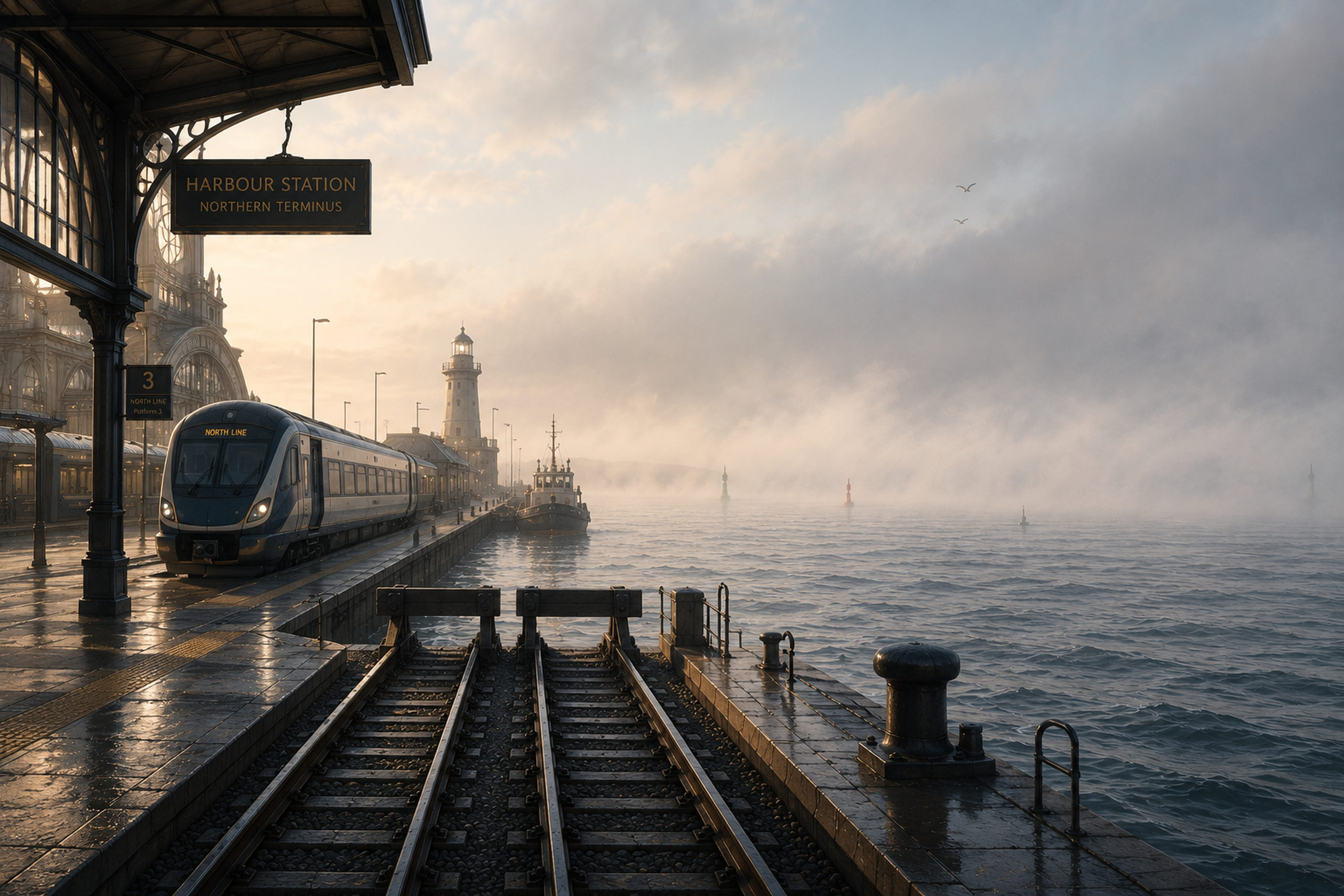
Behind them stood everything the Railway had learned while becoming the Railway. He turned towards the modern map. Followed the western line. Past stations. Junctions. Settlements. All the way to Harbour Station, at the edge of the port.
Beyond it, the map turned blue.
Open sea.
No tracks.
The sea could lead anywhere.
The Railmaster put one finger on Harbour Station. Then moved it into the blue.
“Last time, they had to go all in.”
The Engineer nodded.
“They had no Railway behind them.”
“We do.”
Nobody answered.
The 08:12 began leaving beneath them. The Railmaster kept his finger in the blue.
“What if we didn’t have to choose?”
“Choose what?” asked the Observer.
“Between running what we’ve built and exploring what else we might build.”
The Captain looked at him.
“What if a few of us, some of the time, could explore again?”
The Engineer looked towards the station.
“And all of this?”
“Keeps running.”
“And improving?”
“Of course.”
The Scout looked at the empty blue.
“Explore what?”
The Railmaster looked at the modern map. Then the old one.
“I don’t know.”
The clock showed 08:13. For the first time in years, the morning checkpoint had run over.
Nobody moved.
The Railmaster smiled.
“That’s what we’d have to find out.”
From beside the map, he looked through the western window. The morning remained clear. Harbour Station lay at the edge of the water, its tracks, signals and quays still sharp in the sunlight. Beyond the port, the open sea caught the same light.
Farther out, near the horizon, a thin bank of fog had appeared.
It had not reached the harbour.
The Railmaster watched it for a moment.
Slowly, almost imperceptibly, it was moving towards the port.