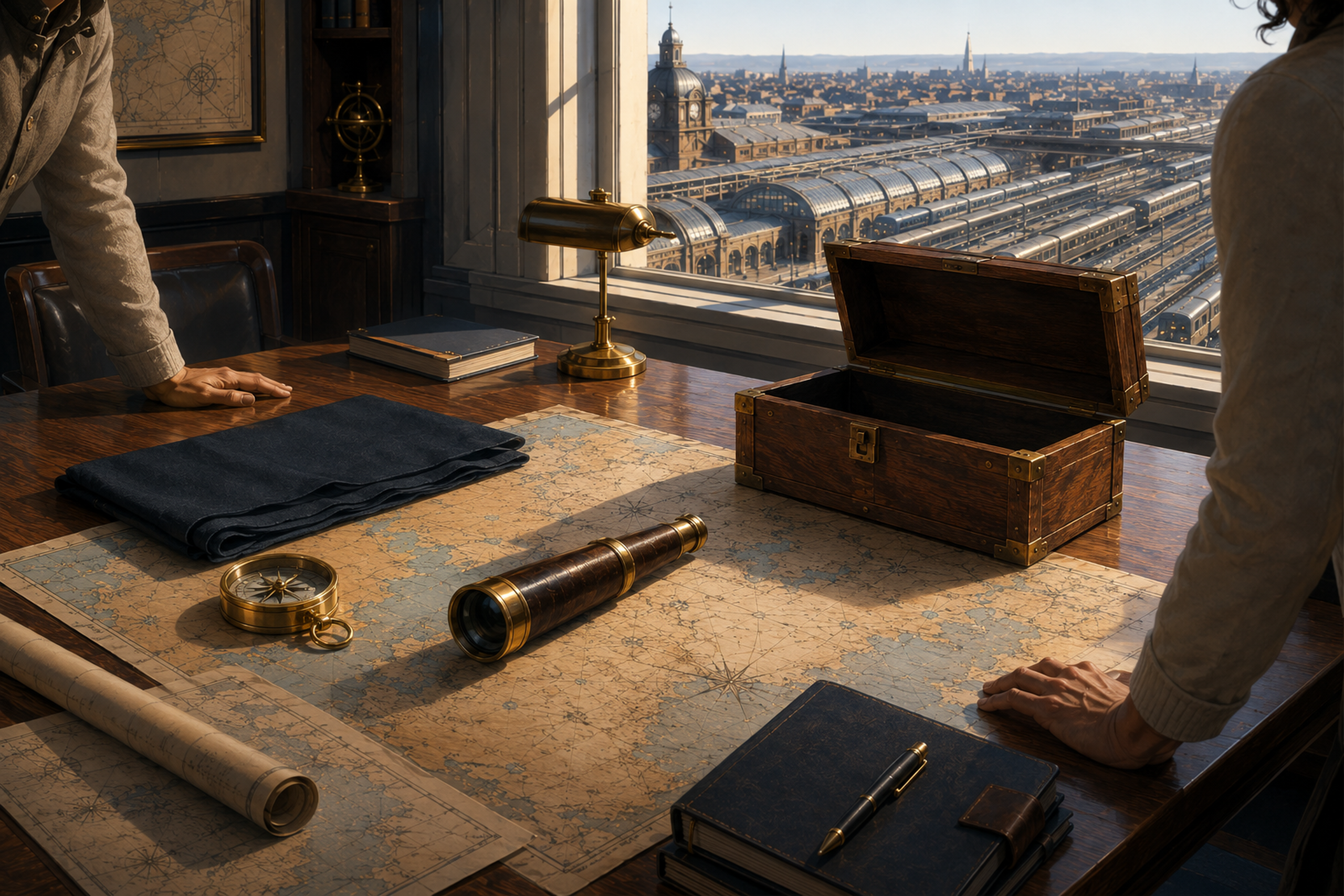
PART I / CHAPTER 2 / BEFORE WE SAIL
It was 08:22. The Scout was halfway to the door.
“Where are you going?” asked the Railmaster.
“To prepare.”
“You have permission to prepare. That is not the same thing as being prepared.”
The Scout returned. The Railmaster looked at the five.
“You are proposing an Expedition. Decide what belongs on it.”
The Scout began listing possibilities. Research. Specialists. Technology. Operations. Commercial. Finance. Communications. Legal. The Engineer watched the list grow.
“Useful,” he said. “But which of those needs to sail?”
The Scout looked at the list again. They had already settled the crew: five would sail. The rest of the Railway would stay where it was useful until the Expedition had a specific reason to call on it.
“So this isn’t a list of people,” said the Navigator.
“It’s a list of access,” said the Captain.
That changed the preparation immediately.
At three that afternoon, the five met again. The Scout arrived with a photograph of a ship. It was enormous. Several decks. Satellite equipment. A crane. A helicopter on the stern. The Engineer looked at it.
“No.”
“You haven’t heard the proposal.”
“No.”
“It has excellent range.”
“No.”
“A helicopter.”
“Especially no.”
The Captain put the photograph aside.
“We are finding out.”
“It would be useful.”
“So would buying a port.”
The Navigator opened the old map.
“What do we actually need before we leave?”
The room quieted. The Railmaster had given them three things to settle. Who were they going for? What were they trying to find out? What would make anything they brought back worth bringing home? The Captain wrote:
FLAG
The Scout looked at her.
“We need a flag?”
“Yes.”
“A real one?”
“Eventually.”
“What does it mean?”
“Who we sail for.”
That sounded simple. It was not. Customers?
“Which customers?” asked the Observer.
“Railway customers.”
“That already assumes anything we find belongs inside what the Railway does today.”
Employees? Passengers? Communities? Owners? All mattered. None was large enough. The Captain looked through the window at the Railway laid out clearly below them.
“The Railway.”
Nobody argued. Not the trains alone. Not the current business model. Not only the people travelling today. The organisation. Its people. Its accumulated capabilities. The communities around it. The value it had learned to create. Whatever the Expedition found would eventually have to return there. The Observer wrote beneath the word:
THE RAILWAY
The Captain read it aloud.
“Who do we sail for?”
“The Railway,” said the Engineer.
That became the Flag. The Navigator looked at the blank water beyond the last line on the old map.
“We don’t know where we’re going.”
“No,” said the Captain.
“That doesn’t mean we can sail without a bearing.”
She wrote:
SPYGLASS
The Scout brightened.
“Now we need equipment.”
“We already have one.”
The Navigator placed a simple Spyglass on the table. The Engineer picked it up.
“What does this mean?”
“The Challenge,” said the Navigator. “The Flag tells us who we sail for. The Spyglass tells us what we’re trying to see.”
They needed a question sharp enough to guide exploration without deciding the answer. The first attempts failed. What else could the Railway do? Too broad. Where are the new growth opportunities? Too commercial. What businesses should the Railway enter?
Too early. What lies beyond rail? Too likely to make not-rail the objective. The Observer looked at the old map.
“The tracks matter.”
The Scout frowned.
“I thought the whole point was getting away from them.”
“No.”
She traced one line.
“The Railway works because of what it has built on them.”
The Engineer nodded.
“The tracks aren’t the problem.”
“They just tell us where the current journeys can go.”
The Captain wrote slowly:
WHAT VALUABLE NEW FUTURES COULD THE RAILWAY CREATE BEYOND THE REACH OF THE TRACKS IT ALREADY HAS?
Nobody spoke.
The Engineer read it twice.
“So not necessarily rail.”
“No.”
“Not necessarily transport.”
“No.”
“Not necessarily current customers.”
“No.”
“But still for the Railway.”
“Yes.”
The Scout looked towards the window.
“And the sea?”
The Observer smiled.
“The sea is where our tracks stop.”
The Captain shook her head.
“The sea isn’t the answer.”
“No.”
“It’s where we start looking.”
The Navigator raised the Spyglass.
“You can’t look everywhere through this.”
“That’s the point.”
The Challenge would not tell them what to find. It would tell them what deserved attention. The Captain wrote the third word.
TREASURE
The Scout smiled.
“Finally.”
“What counts as Treasure?” asked the Captain.
“Something new.”
“No.”
“Something valuable.”
“Better.”
“A future.”
“Perhaps.”
The Navigator looked at the Challenge.
“If we’re bringing something home, it has to matter to that.”
The Engineer added:
“And not threaten what already works just because it is new.”
The Captain wrote:
A NEW FUTURE WORTH PURSUING ALONGSIDE THE RAILWAY.
SIGNIFICANT ENOUGH TO MATTER.
CREDIBLE ENOUGH TO DESERVE A NEXT DECISION.
POSSIBLE TO PURSUE WITHOUT RISKING OR REPLACING WHAT ALREADY WORKS.
The Scout read it.
“That’s Treasure?”
“That’s the standard for the future we’re ultimately trying to find.”
The Observer looked at the empty chest they had brought into the room.
“So anything interesting goes in there?”
“No.”
The Captain closed the lid. They might find discoveries. Patterns. Capabilities. Questions. Keys. Possible futures. Not everything valuable deserved Commitment.
“Only what we have qualified and deliberately committed to carrying forward goes in here.”
The Engineer nodded.
“End-of-phase deliverables.”
The Scout made a face.
“Least pirate-like description of treasure I’ve ever heard.”
“It is still the rule.”
The Navigator looked at the board. Flag. Spyglass. Treasure. Three anchors. Who we sail for. What we are trying to answer. What earns the right to continue. By evening, the equipment list had shrunk. No helicopter. No floating headquarters. No standing support team. A proper vessel. Safe. Capable.
Large enough for five people and their work. Small enough that nobody could mistake the Expedition itself for the achievement. The Scout studied it.
“It’s small.”
“So is the bet,” said the Captain.
They took what mattered. The Railway Flag. The Spyglass. The empty Treasure chest. The old map. Notebooks. Access back to the Railway. Everything else stayed where it was until a specific need called for it.
Two days later, at 06:50, they stood aboard the ship at Harbour Station. The Railmaster was on the quay.
The Railway Flag moved above them. The Treasure chest was empty. The Spyglass lay beside the Captain.
“Flag?” asked the Railmaster.
“The Railway,” said the Scout.
“Spyglass?”
The Navigator read:
WHAT VALUABLE NEW FUTURES COULD THE RAILWAY CREATE BEYOND THE REACH OF THE TRACKS IT ALREADY HAS?
“Treasure?”
The Engineer looked at the empty chest.
“Only what earns the right to continue.”
The Captain added:
“Ultimately, a future worth pursuing alongside the Railway. Significant enough to matter. Credible enough to deserve a next decision. Possible without risking or replacing what already works.”
The Railmaster nodded.
“And while you’re gone?”
“The Railway keeps running.”
“And?”
“It keeps getting better.”
He looked at the five.
“Good.”
Then at the Captain.
“Bring my people back.”
“All five?”
“Preferably.”
The lines were released. The ship began moving away. The Navigator opened the old map. The Engineer looked back at Harbour Station. The Observer watched the Railway become smaller in the clear morning light. The Scout looked ahead. Beyond the harbour mouth, a pale bank of fog lay across the open water. The known world ended in sunlight. The Unknown began in grey. The Captain raised the Spyglass. The Railmaster called from the quay:
“Don’t mistake distance travelled for progress.”
The Captain lowered the Spyglass and nodded. The harbour remained crisp and clear behind them. Ahead, familiar edges softened into grey. For the first time in their working lives, all five were moving forward with no tracks beneath them.
They could not see through the fog.
They would have to learn their way into it.
The Navigator looked at the old map. Behind the ship, she could still draw what they knew. Ahead, she left the paper unresolved.