PART II / CHAPTER 3 / THE VIEW FROM AFAR
By the fourth morning, the Railway had disappeared behind the curve of the coast.
The Scout was the first to notice.
He had been standing at the bow, looking ahead as usual, when he turned and found only sea behind them.
“No tracks.”
The Engineer looked over the rail.
“There haven’t been tracks for four days.”
“That’s not what I mean.”
The others turned.
The land they had come from was gone.
The Railway was still running. They knew that.
Trains were leaving Central Station.
The Railmaster would already have completed the morning checkpoint.
Somewhere, someone was probably trying to remove another few seconds from a turnaround.
But from where the five stood, none of it could be seen.
Ahead was worse.
Fog had been gathering since dawn.
At first it was a pale line on the horizon.
Then the line rose.
By late morning, the sea ahead had become a wall of white.
The Captain raised the Spyglass.
Nothing.
The Navigator checked the chart.
“There’s a harbour two miles north.”
“Can we make it?”
“We can see that far.”
The Captain lowered the Spyglass.
“Then that’s far enough.”
They turned towards shore.
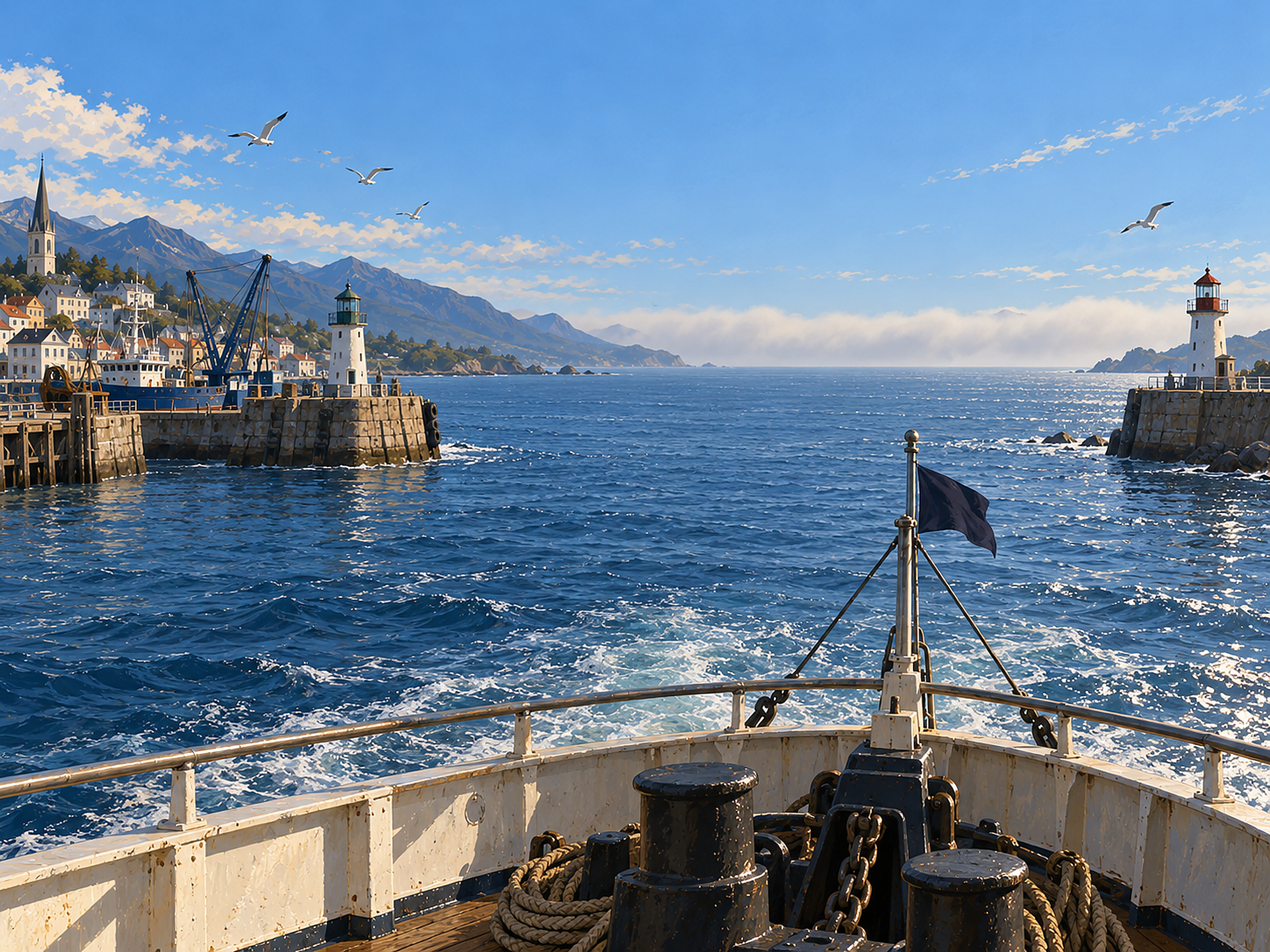
The harbour appeared slowly out of the fog.
A breakwater first.
Then cranes.
Warehouses.
Roofs climbing the hillside.
The town had grown around the water rather than a station.
Goods moved through sheds beside the quay.
Fishing boats shared space with construction vessels and small cargo ships.
The Expedition vessel tied up shortly after noon.
The Scout looked beyond the harbour entrance.
The fog had thickened again.
“So we wait?”
“For now,” said the Captain.
DAY ONE
They had expected an afternoon ashore.
They did not get one.
The call came from the harbourmaster before they had finished tying the last line.
A working vessel had struck something close to the harbour entrance.
The fog had made the approach difficult.
The vessel was not sinking.
But something below deck had been damaged badly enough that bringing it through the channel under its own power was risky.
The harbourmaster looked at the Expedition ship.
“You have engineers?”
The Engineer was already listening.
“One.”
“Enough?”
The Engineer looked towards the white harbour entrance.
“We’ll find out.”
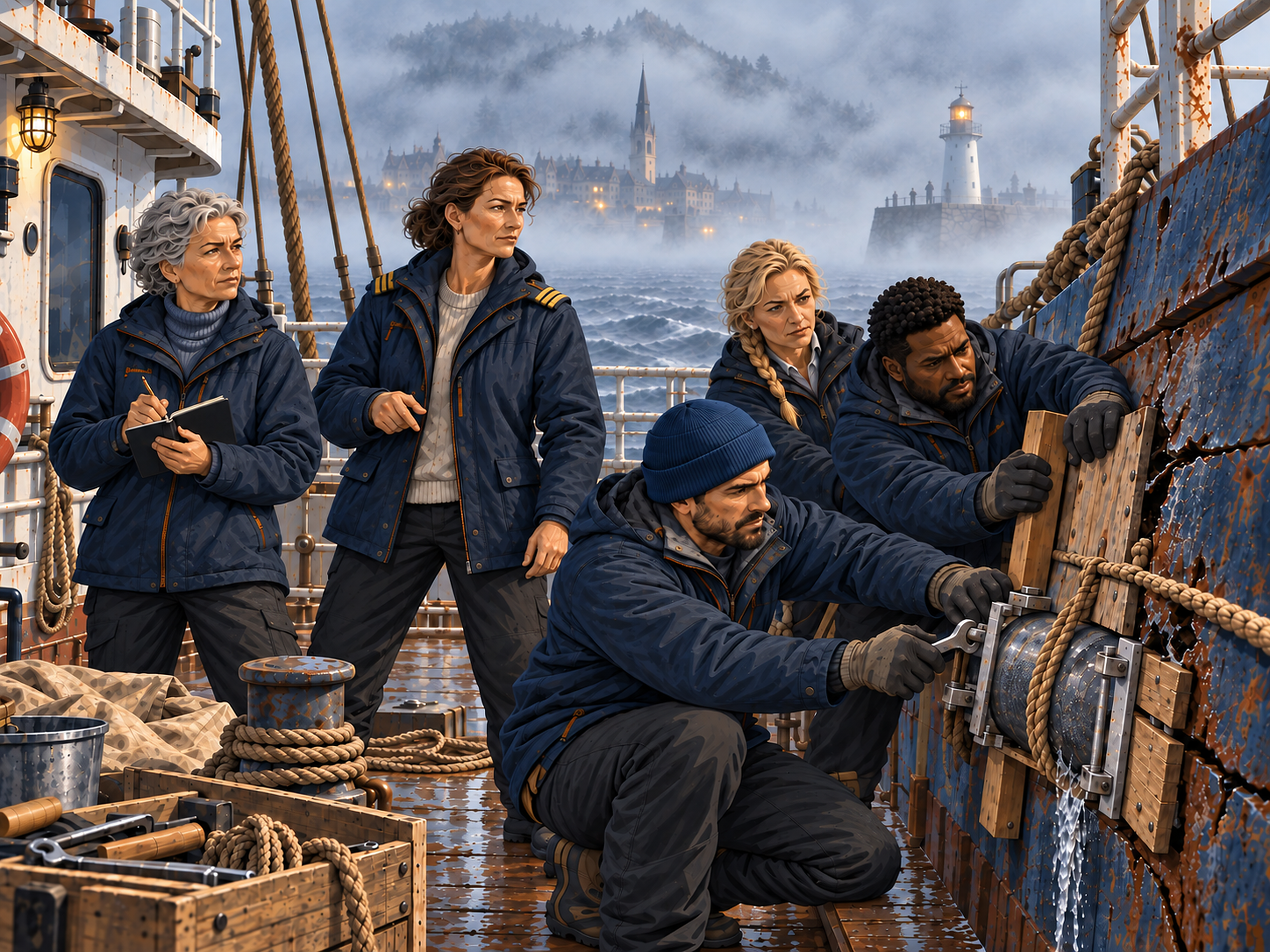
They took a small harbour boat out.
The damaged vessel appeared suddenly through the fog.
Dark hull.
Work deck.
Crew waiting.
No Railway anywhere.
The Engineer and Navigator climbed aboard.
The others followed.
The problem was clear enough.
The solution was not.
A damaged assembly could be held temporarily.
If they could secure it.
The tool they needed was not aboard.
The harbour workshop had one.
But the fog had closed again and getting back would take too long.
The Engineer looked through what the vessel carried.
Then through what they had brought.
A steel bracket.
A length of pipe.
Two clamps.
A cutting tool.
A fitting that could be removed temporarily.
The skipper watched him.
“You’re missing the tool.”
“Yes.”
“So?”
The Engineer held up the pipe.
“We make one.”
The skipper laughed.
Then realised nobody else was laughing.
The crew began moving.
The Navigator stabilised the working position.
The Scout found material.
The Observer worked with the vessel’s crew.
The Captain coordinated the two groups and then stepped aside.
The Engineer measured.
Cut.
Modified.
Tested.
Changed it.
Tested again.
The first version failed.
He changed the angle.
The second slipped.
He added the bracket.
The Navigator looked at it.
“That was part of our ship.”
“Temporarily.”
“You hope.”
“Yes.”
They tested again.
This time it held.
By late afternoon, they had built a tool that had not existed that morning and used it to make a repair nobody had planned.
The vessel moved slowly towards harbour.
The improvised tool remained on deck beside them.
The skipper picked it up.
“You carry one of these for emergencies?”
“No.”
“Where did you get it?”
“We made it.”
The skipper looked at the Engineer.
“How did you know how?”
The Engineer hesitated.
He had no useful answer.
“Railway.”
The skipper laughed.
There was not a track in sight.
Then he looked at the repair again.
“I’d steal that from you.”
“The tool?”
“No.”
The skipper handed it back.
“The way you people started fixing the problem before anybody had decided whose problem it was.”
The Engineer looked at him.
The skipper shrugged.
“In most large organisations, we would still be finding the right person to approve the wrong tool.”
The line stayed with him.
Back aboard that evening, the improvised tool sat in the middle of the supper table.
Nobody had planned to put it there.
The Scout had carried it back.
The Engineer looked at him.
“Why?”
“I like it.”
“It’s scrap.”
“That’s why I like it.”
The Captain looked at the Engineer.
“What did the skipper mean?”
The Engineer knew exactly which line she meant.
“He liked the repair.”
“No.”
The Observer looked at him.
“He liked how you knew what to do.”
“I didn’t.”
“You made something.”
“So would anyone.”
The Scout picked up the improvised tool.
“Would they?”
The Engineer started to answer.
Then stopped.
He had heard the stories as an apprentice.
The first Railway builders had worked far beyond workshops and reliable supply.
If they broke a tool, another one might be days away.
If a part did not fit, they changed it.
If the drawing and the mountain disagreed, the mountain won.
If the person authorised to decide was fifty kilometres down the line, somebody standing in the mud still had to make the decision.
The tracks had not advanced because every problem had a procedure.
They had advanced because people solved what was in front of them.
The Navigator looked at the improvised tool.
“And that survived?”
The Engineer picked it up.
“That’s how we still fix things.”
Nobody spoke for a moment.
The Railway had developed that capability because it needed to build and operate a Railway.
Yet there they were.
At sea.
Using it to repair a vessel.
The Scout looked at the Engineer.
“So something built for one world travelled into another.”
The Engineer shrugged.
“It was a repair.”
“Yes.”
“A fairly ugly one.”
“Yes.”
The Scout smiled.
“And the skipper wanted what made it possible.”
The Captain looked at the tool.
Not the object.
What sat underneath it.
Accumulated experience.
Practical judgement.
Authority close to the problem.
The ability to improvise.
People accustomed to acting together.
Capabilities so ordinary inside the Railway that the people carrying them barely recognised them.
The Observer pulled a blank page towards her.
“What else do we have like that?”
The Engineer laughed.
“Like scrap metal?”
“Like something we stopped seeing because we have always had it.”
The Captain looked towards the harbour.
The fog still covered the way out.
The Navigator understood first.
“Something another organisation would have difficulty simply buying.”
“Or building quickly,” said the Observer.
The Scout looked at the improvised tool again.
“An advantage.”
The Engineer sighed.
“We have lots of advantages.”
The Scout shook his head.
“Not like that.”
“What kind, then?”
“The kind someone else would think was unfair.”
The Engineer looked at him.
“Unfair?”
“Not wrong.”
The Scout shrugged.
“Just difficult to start without.”
The Observer wrote:
UNFAIR ADVANTAGES
The name looked larger than the one experience beneath it.
The Captain noticed.
“One repair doesn’t make a lens.”
“No,” said the Observer.
“But it gives us somewhere to look.”
The Captain nodded.
“Then tomorrow we look properly.”
That changed the evening.
They had done nothing yet except notice something strange.
One experience.
One outsider seeing something in them they barely saw themselves.
The repair had not proved they possessed a great advantage.
It had shown them where to look.
Now they needed ways to look deliberately.
The Observer drew a line down the middle of a blank page.
On one side she wrote:
ASK FROM OUTSIDE
On the other:
STEP OUTSIDE AND LOOK BACK IN
The Scout looked at her.
“Difference?”
“Sometimes we can ask somebody what they see in us.”
She tapped the other side.
“Sometimes the person we need is not standing in this harbour. Then we borrow their eyes.”
“Pretend to be them?”
“Not pretend to know everything they know.”
The Captain answered.
“Just force ourselves out of our own view.”
The Engineer looked at the improvised tool.
“The skipper saw something because he wasn’t Railway.”
“Exactly.”
The Observer pulled a clean sheet of paper towards the middle of the table.
“Then every Assignment should give us another outside view.”
They began writing possible Assignments down the page.
The Scout leaned over it.
“The skipper saw something in us we barely saw ourselves.”
He wrote:
UA01 · THROUGH THEIR EYES
Underneath:
What would someone outside the Railway envy about us, and why?
“Not just someone,” said the Navigator.
“Different someones.”
A powerful founder.
A startup team.
A student.
A government.
A charity.
An investor.
A country.
Anyone far enough from the Railway to make the familiar look strange.
The Scout nodded.
“Profiles.”
“Real people when we can reach them,” said the Observer.
“Borrowed eyes when we cannot.”
The Navigator took the pen.
“If we vanished tomorrow, what would actually be missing?”
She wrote:
UA02 · WORLD WOULD MISS
The Captain took the pen next.
“If someone bet serious money on us, what competence would they make certain we used?”
She wrote:
UA03 · INVESTOR BET
The Scout added:
UA04 · INDUSTRY ENVY
“What would other players in our Domain envy, and why?”
The Engineer looked at the improvised tool.
“What do we already do that others seem unable to compete with?”
He wrote:
UA05 · WORLD CLASS
The Observer added:
UA06 · IN YOU WE TRUST
“Who in our Domain would especially trust us with something?”
“With what?” asked the Scout.
“And why,” she said.
The list kept growing.
UA07 · PAY US TO WORK
Who would pay us to do our work, for what, and why?
UA08 · IMPRESS
What could this team do that would genuinely impress the world, and why?
UA09 · ADMIRED
Who do we admire, and what would they admire in us?
UA10 · POWER PLAYER
What can the most powerful players in our Domain not do that we can, and why?
UA11 · STARTUP
Where could a startup beat the establishment, and what advantage does that reveal in us?
UA12 · THE CROWD
Where could the crowd beat the establishment, and what advantage does that reveal in us?
The Engineer counted the Assignments on the sheet.
“Twelve.”
The Scout added one more line.
“Thirteen.”
He wrote:
UAXX · WILDCARD
The Captain looked at him.
“What does that one ask?”
“Whatever the others failed to ask.”
The Observer smiled.
The Scout continued.
“What do we know, have or do that somebody else would envy, value, trust or struggle to replicate?”
The Engineer looked at the list.
“This is a lot to learn from one bad repair.”
The Captain shook her head.
“We are not learning all of this from the repair.”
She touched the improvised tool.
“This gave us the lens.”
Then the sheet of Assignments.
“These give us different places to stand.”
That distinction mattered.
The experience had revealed the possibility of an Unfair Advantage.
The Assignments would search for more.
Some would send them to outsiders.
Some would make them borrow somebody else’s eyes.
Some might produce several Discoveries.
Some might produce none.
The objective was not to make every Assignment succeed.
It was to search broadly enough that the Railway could be seen from perspectives the Railway itself rarely occupied.
The Observer looked at the page.
“We should take them with us tomorrow.”
The Scout glanced at the damp harbour outside.
“Not like that.”
The Engineer found a stack of small blank field cards in the chart-room drawer.
They copied one Assignment onto each card.
A title on the front.
The question underneath.
Nothing more.
Portable enough for a coat pocket.
Simple enough to hand to a buddy.
By the time they were done, thirteen Assignment cards lay in a row across the table.
The Scout looked towards the fogged harbour entrance.
“All tomorrow?”
“We work the whole deck,” said the Captain.
“All twelve?”
“And the Wildcard.”
The Engineer looked at the clock.
“That is ambitious.”
“We do not need a ceremony for each one,” said the Observer.
“Some will take an hour. Some ten minutes. Some will send us ashore. Some we can work together at this table.”
The Navigator looked at the row of Assignment cards.
“And when do we stop?”
The Captain looked at the blank pages waiting beside them.
“When another Assignment, another profile or another conversation mostly gives us more of what we already know.”
The Engineer smiled.
“Clear as fog.”
Nobody improved on it.
DAY TWO
The town was visible in the morning.
The sea beyond it was not.
They met on deck.
The Flag moved lightly above them.
The Captain looked at it.
Then at the Spyglass.
Then at the Treasure chest.
Then at the row of Assignment cards.
“Same Flag. Same line of sight. Same Treasure. New Assignments.”
It was the first time the phrase felt like something they might say again.
They worked in buddy pairs, changing partners and cards through the day.
No one owned an Assignment.
Some cards required another person’s actual view.
Others required the crew to step outside themselves and look back through borrowed eyes.
They would work every card.
But they would not experience every card in the same way.
A few would take them into long conversations.
Some would be answered through observation.
Some would be hard thought experiments between two crew members.
Some would lead nowhere.
That was allowed.
The purpose was not to fill twelve cards.
It was to make twelve deliberate attempts to see what familiarity had hidden.
They started with the Assignments that pulled them most strongly towards the world outside.
They went ashore.
THROUGH THEIR EYES
The Navigator returned to the waterfront.
This time she did not ask what people thought about trains.
She asked what they saw when they looked at the Railway from outside it.
A property developer answered quickly.
“Relationships.”
The Navigator had expected land.
The developer laughed.
“Land I can buy.”
He pointed towards the town behind them.
“History I cannot.”
Who knew the municipality?
Who had dealt with the same landowners for years?
Who could call local businesses and have the call returned?
Who had already survived disagreements and still been there the following year?
“If I arrive with money,” the developer said, “people want to know what I am trying to take from them.”
He looked at the Navigator.
“If you call, they already know who you are.”
The Navigator had never thought of that as an asset.
It was simply how things worked.
That evening it became:
A PROPERTY DEVELOPER ENVIES OUR LOCAL RELATIONSHIPS BECAUSE MONEY CAN BUY THE SITE, NOT THE HISTORY AROUND IT.
The Observer used the same Assignment with different people.
A community organiser.
A supplier.
A municipal planner.
A former contractor.
Different language.
Similar territory.
Access.
Trust.
Permission.
Continuity.
Things created slowly enough that the Railway had stopped noticing how long they took to build.
INVESTOR BET
The Captain and Observer worked this one together.
The card did not tell them to find an investor.
It told them to borrow one.
If an investor bet serious money on the Railway, what competence would they make certain we leveraged, and why?
The Captain answered first.
“Our network.”
“Asset,” said the Observer.
“Stations.”
“Asset.”
“Land.”
“Asset.”
The Captain looked irritated.
“That is most of the Railway.”
“Then what would the investor make certain the Railway actually did with it?”
They sat with that.
The Captain began describing an ordinary operating day.
Trains.
Signals.
Crews.
Maintenance.
Platforms.
Contractors.
Freight.
Passengers.
Weather.
Exceptions.
Thousands of actions.
No single person controlling all of them.
Yet somehow they became one operating system.
The Observer looked up.
“That.”
“What?”
“The competence underneath all of it.”
They did not trust their own answer yet.
So they took the thought experiment ashore and tested it with the manager of a harbour logistics operation.
The Captain described the same operating day.
He listened.
Then asked who coordinated all of it.
“No single person.”
He laughed.
“I can buy software.”
The Captain waited.
“I can hire consultants.”
He pointed towards the harbour.
“What I cannot buy quickly is an organisation that has learned to coordinate that much complexity every day without collapsing under it.”
Back aboard, the Captain wrote:
AN INVESTOR WOULD BET ON OUR OPERATING COORDINATION BECAUSE THOUSANDS OF PEOPLE AND ASSETS CAN WORK AS ONE WITHOUT ANYONE CONTROLLING ALL OF IT.
She had spent most of her career inside that capability.
It had taken borrowed eyes to make it visible.
INDUSTRY ENVY
The Scout and Navigator took the card to the end of the quay.
What would another player in our Domain envy about us, and why?
They began with the obvious.
Tracks.
Stations.
Brand.
Scale.
Then the Navigator stopped them.
“Those are things we own.”
“What else would they envy?”
The Scout watched people crossing the harbour terminal.
“People.”
“Employees?”
“No.”
He looked back at the card.
“People who show up without being invited.”
Every morning, people arrived at Railway stations.
Every afternoon, they came back.
At known places.
At roughly known times.
Again and again.
The Navigator tested the thought from a challenger’s position.
“If I were a startup trying to enter our Domain tomorrow, I would have to spend years getting people to come to me.”
The Scout nodded.
“We already sit inside where their lives happen.”
They tested the thought with an entrepreneur they met near the market.
“What would you steal from the Railway?”
“The people.”
“Which people?”
“All of them.”
The Scout smiled.
The entrepreneur continued.
“You think they come because they need trains.”
“They do.”
“Yes. And while doing that, they have spent generations teaching themselves to come to your places.”
The Scout looked towards the harbour.
“If you had our stations?”
“I wouldn’t use them only for trains.”
Back aboard, the card became:
A CHALLENGER WOULD ENVY OUR STATIONS BECAUSE PEOPLE ALREADY ARRIVE THERE, AT KNOWN PLACES AND TIMES, AGAIN AND AGAIN.
Not an idea for a future.
Not yet.
A Discovery about something the Railway possessed that another player would struggle to recreate.
WORLD CLASS
The Engineer had resisted the Assignment because he disliked the name.
“World-class.”
The Scout had enjoyed that immensely.
The Engineer returned first to the workshop near the harbour.
He asked what the Railway seemed unusually good at.
Most answers were useless.
Scale.
Engineering.
Safety.
Infrastructure.
All true.
None specific enough.
The workshop owner eventually brought up the damaged vessel.
“You people didn’t spend much time deciding who owned that problem.”
“We were there.”
“That isn’t what I mean.”
He pointed towards the harbour.
“You started fixing it.”
The Engineer looked at him.
“Wouldn’t you?”
“In a workshop this size? Yes.”
“And in a larger company?”
The man smiled.
“That depends how many people need to approve the wrench.”
The Engineer wrote it down.
Later, the same Assignment took him to an industrial operator outside the harbour.
The Engineer described the repair only briefly.
The operator was more interested in how the crew had behaved than what they had built.
“You made the tool you needed?”
“Yes.”
“And nobody stopped you?”
“Why would they?”
The operator laughed.
“That question is your advantage.”
The Engineer waited.
The man continued.
“What I’d envy about the Railway is not that your people can improvise a bracket.”
He tapped the table.
“It is that they start solving the problem before most large companies have decided who owns it.”
The Engineer stopped writing.
It was almost exactly what the skipper had seen the day before.
Different person.
Different setting.
Same capability.
The repair had triggered the lens.
The Assignment had now brought the same thing back deliberately.
That evening it became:
AN INDUSTRIAL OPERATOR ENVIES OUR PRACTICAL PROBLEM-SOLVING BECAUSE OUR PEOPLE START FIXING THINGS BEFORE MOST LARGE COMPANIES HAVE DECIDED WHO OWNS THE PROBLEM.
The Engineer read it twice.
This time he did not object.
THE OTHER ASSIGNMENTS
The four stories above took most of the telling.
They were not the only Assignments the crew worked.
By late afternoon, every card had been used at least once.
Some had been worked several times with different profiles.
Some had been answered through real conversations.
Some by observation.
Some by deliberately borrowing another person’s position and looking back at the Railway from there.
WORLD WOULD MISS surfaced continuity, institutional memory, places people already knew how to use, and the ability to keep operating when something failed.
IN YOU WE TRUST surfaced relationships with communities, authorities, suppliers and partners that could not be reconstructed from a contact list.
PAY US TO WORK forced the crew to ask which parts of ordinary Railway work other organisations might actually pay to access.
IMPRESS produced a long argument about what the Railway could do that would genuinely surprise somebody outside it.
ADMIRED made them borrow the eyes of people and organisations they respected, then ask what those people might respect in return.
POWER PLAYER exposed one promising thought about the Railway’s ability to act locally inside a system of enormous scale.
STARTUP made them ask where a small challenger could beat the establishment, then turn the question back on themselves: which of those challenger advantages did the Railway already possess somewhere inside it?
THE CROWD raised questions about what became possible because millions of people already interacted with the Railway as part of ordinary life.
And whenever the deck itself began to feel like a boundary, they used:
UAXX · WILDCARD
The Wildcard produced questions the original twelve had missed.
Some cards produced several useful observations.
Some produced almost nothing.
A few surfaced strengths that were obviously useful but potentially purchasable or reproducible.
Purchasing power.
A piece of maintenance technology.
A large asset base.
The crew kept those observations too.
This was Discovery.
They were not qualifying anything yet.
They were trying to see broadly before deciding what deserved to travel forward.
By afternoon, the table aboard the ship was filling.
Relationships.
Rights.
Knowledge.
Trust.
Recurring human presence.
Operational coordination.
Practical autonomy.
Local permission.
Infrastructure.
Institutional memory.
The ability to mobilise people.
Some were individual things.
Others seemed powerful only in combination.
The Scout kept adding examples.
The Captain let him.
For a while.
Then something changed.
A different person described the same relationship network.
Another used different words for the same operating coordination.
A third pointed again to the same recurring human presence around Railway places.
The Scout tried to add another heading.
The Captain stopped him.
“What is new?”
“Different person.”
“What did we learn that wasn’t already on the table?”
He looked again.
“Nothing.”
They placed it beside the existing Discovery.
An hour later it happened again.
Then again.
New evidence.
Fewer new headings.
The Observer opened another notebook.
Different source.
Familiar advantage.
The Engineer brought back another example of practical problem-solving.
Already there.
The Navigator had another trust story.
Already there.
The Captain looked across the table.
“What materially changed this afternoon?”
Nobody answered immediately.
The Scout searched his notes.
“More proof.”
“Of?”
“Things we already found.”
The Captain nodded.
They had not run out of people.
They had worked every Assignment.
The Wildcard had given them extra angles.
They could still repeat the cards with more profiles, more conversations and more borrowed eyes.
They had not found every Unfair Advantage the Railway might possess.
They never could.
But another round of searching was increasingly likely to deepen or repeat what was already on the table rather than materially change what they could see.
The Captain touched the improvised tool from the day before.
“One accident showed us where to look.”
Then she touched the Assignment cards.
“These made us look deliberately.”
Then the spread of Discoveries.
“And now?”
The Navigator looked across the table.
“We’re hearing ourselves coming back.”
The Captain nodded.
The Scout looked at the marked Assignment cards.
“So we completed them.”
“We worked them.”
“And now we stop?”
“Because the landscape has stopped changing enough to justify another day.”
The Engineer looked at the deck.
“So completing the Assignments was not the point.”
“No,” said the Captain.
“Discovering the landscape was.”
She looked at the table.
“This one has stopped changing enough to justify another day.”
That settled it.
She drew a line beneath the final Discovery.
“Freeze it.”
The Engineer looked up.
“All of it?”
“The collection.”
“Not the conclusions.”
“No.”
They did not choose the best.
They did not rank them.
They did not polish them.
They did not ask yet whether something could be done with them.
They did not try to make anyone care.
Those tests belonged later.
They recorded what they had found.
Where it had come from.
What evidence sat behind it.
Later, the Discoveries could face harder tests.
For now, this was the Unfair Advantage Discovery collection the port had given them.
The Captain looked at the improvised tool again.
Yesterday it had been scrap.
Then evidence.
Then a question.
The question had become a lens.
The lens had become Assignments.
The Assignments had become Discoveries.
And the Discoveries had eventually begun returning them to territory they already knew.
The Scout was watching her.
“So that’s how an Expedition works?”
The Captain considered it.
“One port doesn’t make a method.”
The Engineer nodded approvingly.
“But?”
The Scout knew there was a but.
The Captain looked towards the fog outside.
“If it happens again, we’ll know what to notice.”
The harbour entrance was still white.
The Engineer looked through the window.
“So much for being finished.”
The Captain closed the notebook.
“We’ll see in the morning.”
DAY THREE
The Navigator woke first.
Something had changed.
Light was coming through the cabin window differently.
She went on deck.
The harbour was clear.
Beyond the breakwater, the fog had pulled back from the water.
Not disappeared.
Farther out, a pale bank still covered much of the horizon.
But a stretch of open sea now ran between the harbour and it.
Enough to travel.
The others joined her one by one.
The Scout looked from the clear water to the frozen collection.
“That’s convenient.”
“Coincidence,” said the Engineer.
The Captain raised the Spyglass.
For the first time in two days, there was something to see through it.
Open water.
No destination.
No answer.
Just passage.
The Navigator checked the chart.
“There’s another harbour before the visibility closes again.”
“How much margin?”
“Enough.”
The Captain lowered the Spyglass.
“Then we use the opening.”
The Navigator marked the harbour they were leaving.
Beside it she wrote:
UNFAIR ADVANTAGES
The Observer placed the frozen Discovery collection beneath the mark.
The Railway itself was far beyond the horizon now.
Yet after two days away from it, the crew could see part of it more clearly than when they had stood inside it.
The Engineer looked at the improvised tool.
He had expected the Expedition to teach him new ways of solving problems.
Instead, an old way of solving them had followed him to sea.
The Navigator had expected assets to mean land, equipment and infrastructure.
Now relationships, rights, trust and permission sat beside them.
The Scout had expected passengers to be people who needed trains.
Someone outside the Railway had seen recurring human presence.
The Observer had watched outsiders describe ordinary Railway capabilities as if they were extraordinary.
The Captain looked at the Assignment cards.
Every one had been worked.
Some were crowded with notes.
Some carried only a line or two.
The Wildcard had been rewritten more than once.
That mattered too.
A lens was not an answer.
An Assignment was not valuable because it had been completed.
It was a deliberate way to look.
The first strange experience had told them they might be carrying more than they knew.
The Assignments had allowed them to search for it from many outside positions.
And the repetition had told them when the search, for this port and this available time, had gone far enough.
They had not found a future.
They had found something more basic.
What the Railway might be able to bring into one.
The lines were released.
The ship moved through the breakwater.
Behind them, the port became smaller.
Ahead, clear water narrowed towards fog.
For now, there was enough sea to continue.
And somewhere beyond it, another harbour.